 Instructional Biology
Two goals that got treated as one
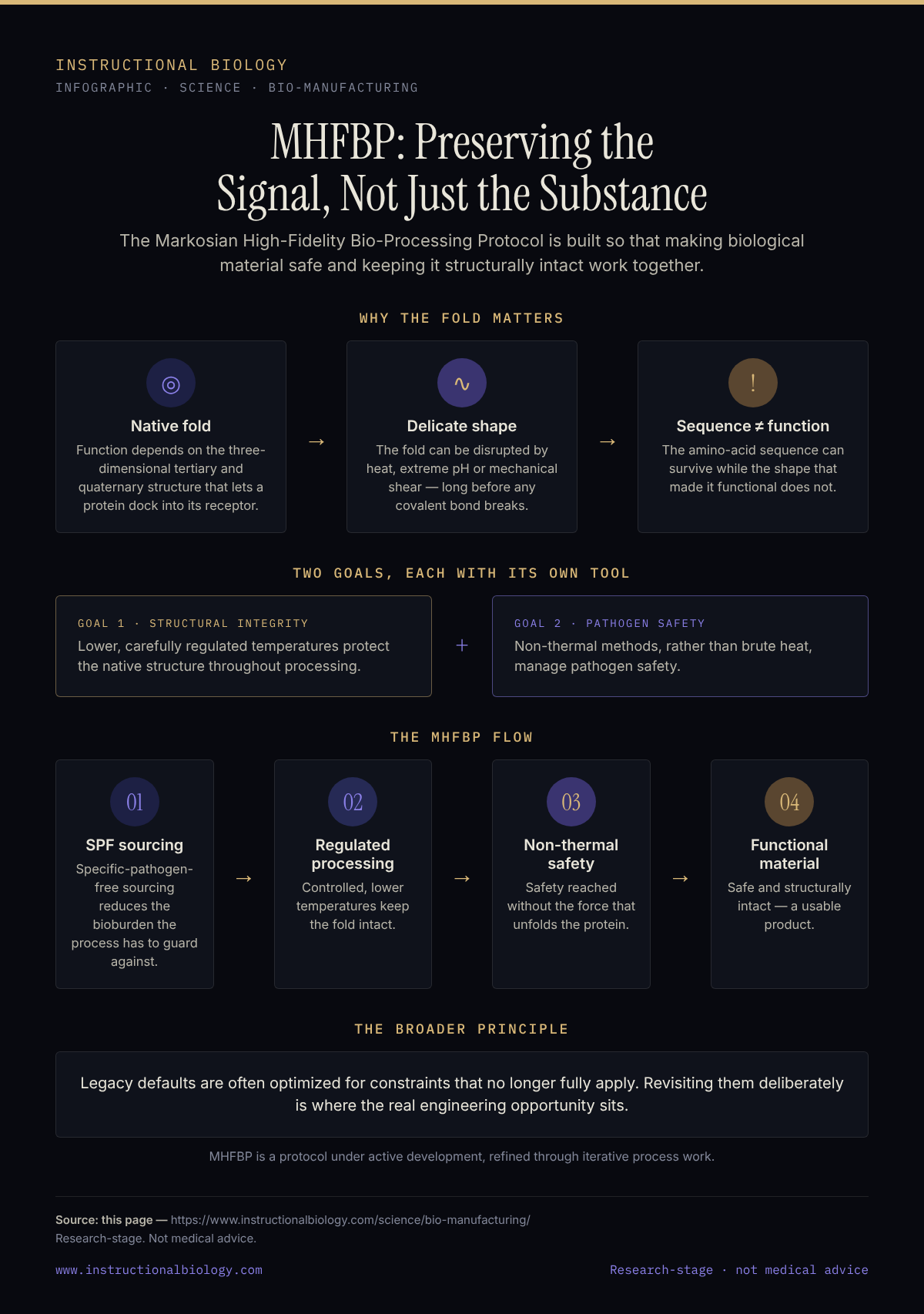
A protein's biological function depends on its three-dimensional fold — the specific tertiary and, for larger complexes, quaternary structure that lets it dock into a receptor or interact with another molecule the way it's meant to. That fold is delicate. It can be disrupted by heat, by extreme pH, by mechanical shear, long before any covalent bond in the molecule actually breaks. The amino acid sequence survives; the shape that made it functional doesn't.
Historically, biopharmaceutical processing has optimized hard for one variable — pathogen safety — using tools, chiefly high-heat sterilization, that are excellent at that one job and indifferent to structural preservation as a side effect. That trade-off made sense when there wasn't a practical alternative. It's made less sense as sourcing standards and non-thermal safety technologies have matured, because the two goals were never actually in permanent conflict — they were just usually pursued with tools that forced a conflict between them.
What MHFBP is designed to do differently
MHFBP is a controlled processing protocol built around a straightforward design principle: use lower, carefully regulated temperatures to protect structural integrity, and rely on non-thermal methods — rather than brute heat — to manage pathogen safety. Paired with specific-pathogen-free sourcing, which meaningfully reduces the bioburden a process has to guard against in the first place, this changes how much thermal or chemical force is actually necessary to reach an acceptable safety margin, as opposed to how much has simply been standard industry practice.
The tradeoff is throughput. Lower-temperature, structure-preserving processing is slower than high-heat sterilization, and slower has historically meant less attractive at industrial scale. We think that tradeoff is worth making deliberately rather than avoiding by default — because a faster process that produces structurally silent material isn't actually solving the problem biomanufacturing exists to solve. It's optimizing for a proxy (pathogen safety) at the direct expense of the thing that proxy was supposed to protect (a functional, usable product).
Why this matters beyond one protocol
We think of MHFBP as a case study in a broader principle that shows up across our platform: legacy defaults are often optimized for constraints that no longer fully apply, and revisiting them deliberately — rather than treating them as fixed — is frequently where the real engineering opportunity sits. That's as true of single-target pharmacology as it is of high-heat sterilization. In both cases, the field settled on a working answer decades ago and largely stopped asking whether the constraints that produced that answer still hold.
MHFBP is our answer to that question for biomanufacturing specifically. It remains a protocol under active development, refined through iterative process work, and — like everything else on this page — it's a research-stage capability, not a finished, validated manufacturing standard.