 Instructional Biology
The problem with a single fixed dose
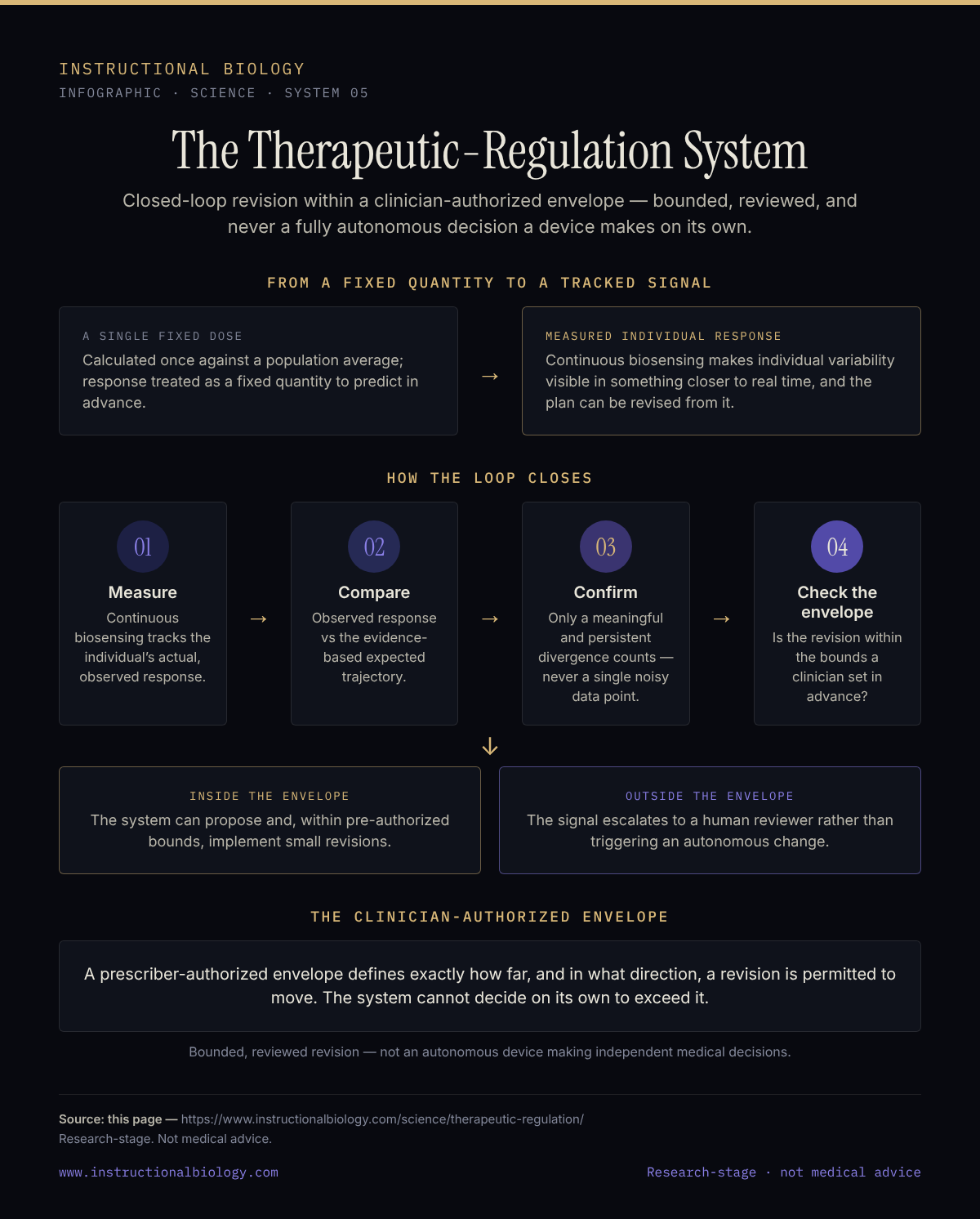
A standard treatment plan, calculated once against a population average, treats a person's response as a fixed quantity to be predicted in advance rather than a signal to be tracked over time. In practice, individual response varies — sometimes substantially — for reasons a one-time calculation was never built to capture. Continuous biosensing makes that variability visible in something closer to real time, rather than retrospectively at the next scheduled visit.
The therapeutic-regulation system is what turns that visibility into something actionable: a closed-loop mechanism for revising a treatment plan based on measured individual response, rather than leaving it fixed until a human happens to notice a problem.
Why "closed-loop" doesn't mean "autonomous"
This is the point we're most careful about, because it's the easiest to overstate. Closed-loop, in our system, means the loop closes within boundaries a clinician has set in advance — a prescriber-authorized envelope defining exactly how far and in what direction a revision is permitted to move. Any signal that falls outside that envelope escalates to a human reviewer rather than triggering an autonomous change. The system can propose and, within pre-authorized bounds, implement small revisions; it cannot decide on its own to exceed the boundaries a clinician has set.
We think this distinction matters enough to repeat: this is bounded, reviewed revision — not an autonomous device making independent medical decisions. We've written more on what this looks like in practice, and why we think the "adaptive" framing gets misused elsewhere in the industry.
No one is the same
Why treatment that responds to measured individual signal is different from a fixed dose that ignores it — and where we draw the line on autonomy.
What decides when a revision is warranted
The measured input driving this system is a comparison between an individual's actual, observed response and what their evidence-based expected trajectory predicted — the same kind of individualized modeling described in our reasoning system and, at a longer time horizon, in our thinking on digital twins. A revision is only proposed when that divergence is meaningful and persistent, not from a single noisy data point. Even then, it's proposed within the clinician's pre-set envelope, not enacted unilaterally.