 Instructional Biology
The problem this system exists to solve
Every biomanufacturing process has to answer the same question: how do you make source material safe without destroying what made it valuable in the first place? For decades, the default answer has been heat — reliable at killing pathogens, and reliably indifferent to the delicate three-dimensional folds that give complex signaling peptides their function. A sterilized-but-structurally-silent extract solves the safety problem while quietly failing the actual goal.
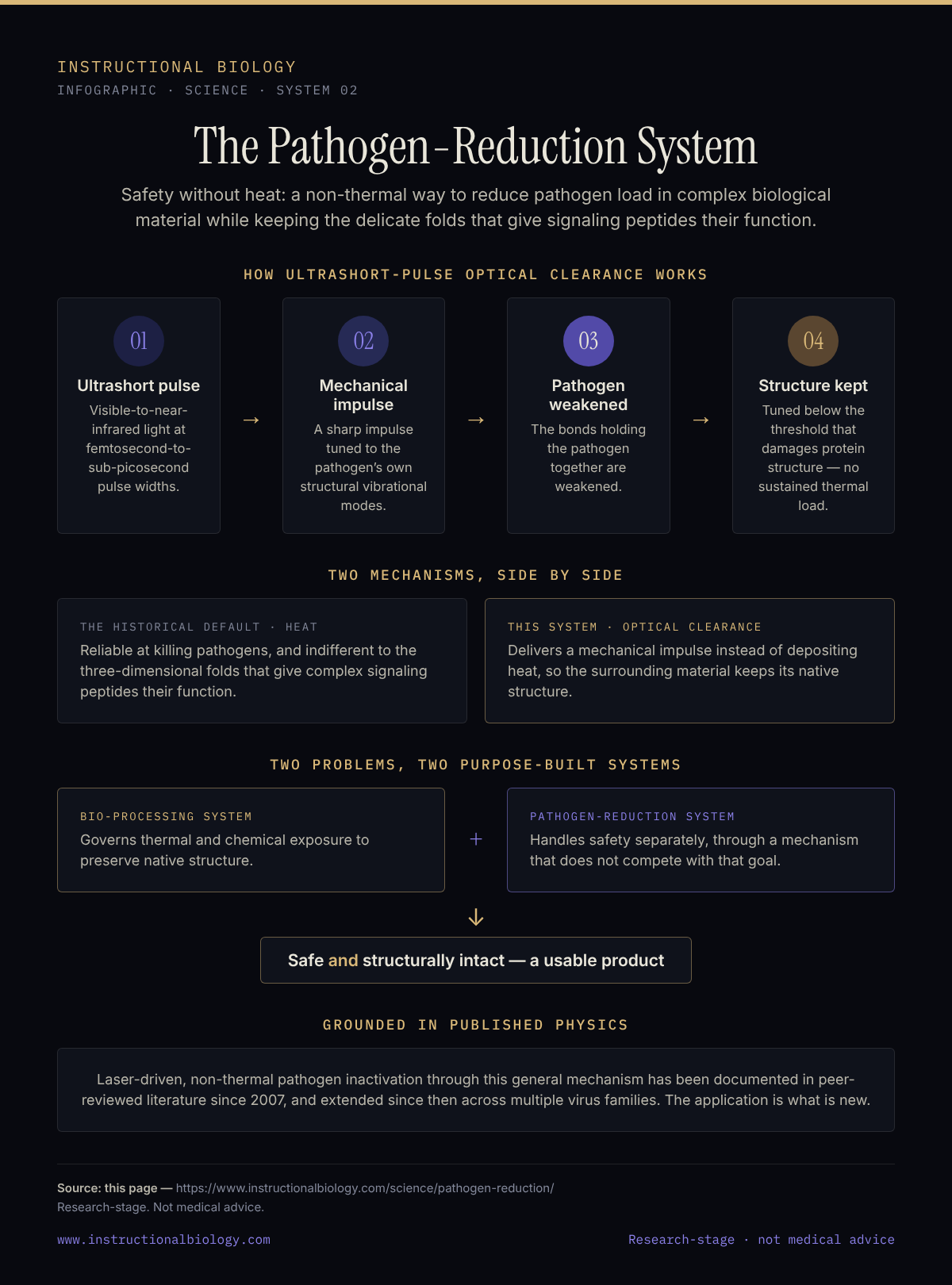
Our pathogen-reduction system is built around a different physical mechanism entirely: ultrashort-pulse optical clearance, operating in the visible-to-near-infrared range at femtosecond-to-sub-picosecond pulse widths, tuned below the threshold that damages protein structure. Rather than depositing heat, it delivers a sharp mechanical impulse tuned to a pathogen's own structural vibrational modes — weakening the bonds holding it together without the sustained thermal load that denatures the surrounding material.
This isn't a novel physical mechanism — the application is what's new
We didn't invent this class of physics. Laser-driven, non-thermal pathogen inactivation through this general mechanism has been documented in peer-reviewed literature since 2007, extended since then across multiple virus families. We've written a full explainer on the underlying mechanism and its published research history — worth reading if you want the physics in depth.
How lasers kill viruses
The full mechanism, with citations to the published research this system builds on.
Why this has to work alongside the bio-processing system, not instead of it
Pathogen safety and structural preservation have historically been treated as a single combined problem, solved with a single blunt tool. We treat them as two distinct engineering problems, each solved by a purpose-built system: the bio-processing system governs thermal and chemical exposure to preserve native structure, and the pathogen-reduction system handles safety separately, through a mechanism that doesn't compete with that goal. Neither system is sufficient alone — safety without structural integrity is a wasted process, and structural integrity without safety isn't a usable product.