 Instructional Biology
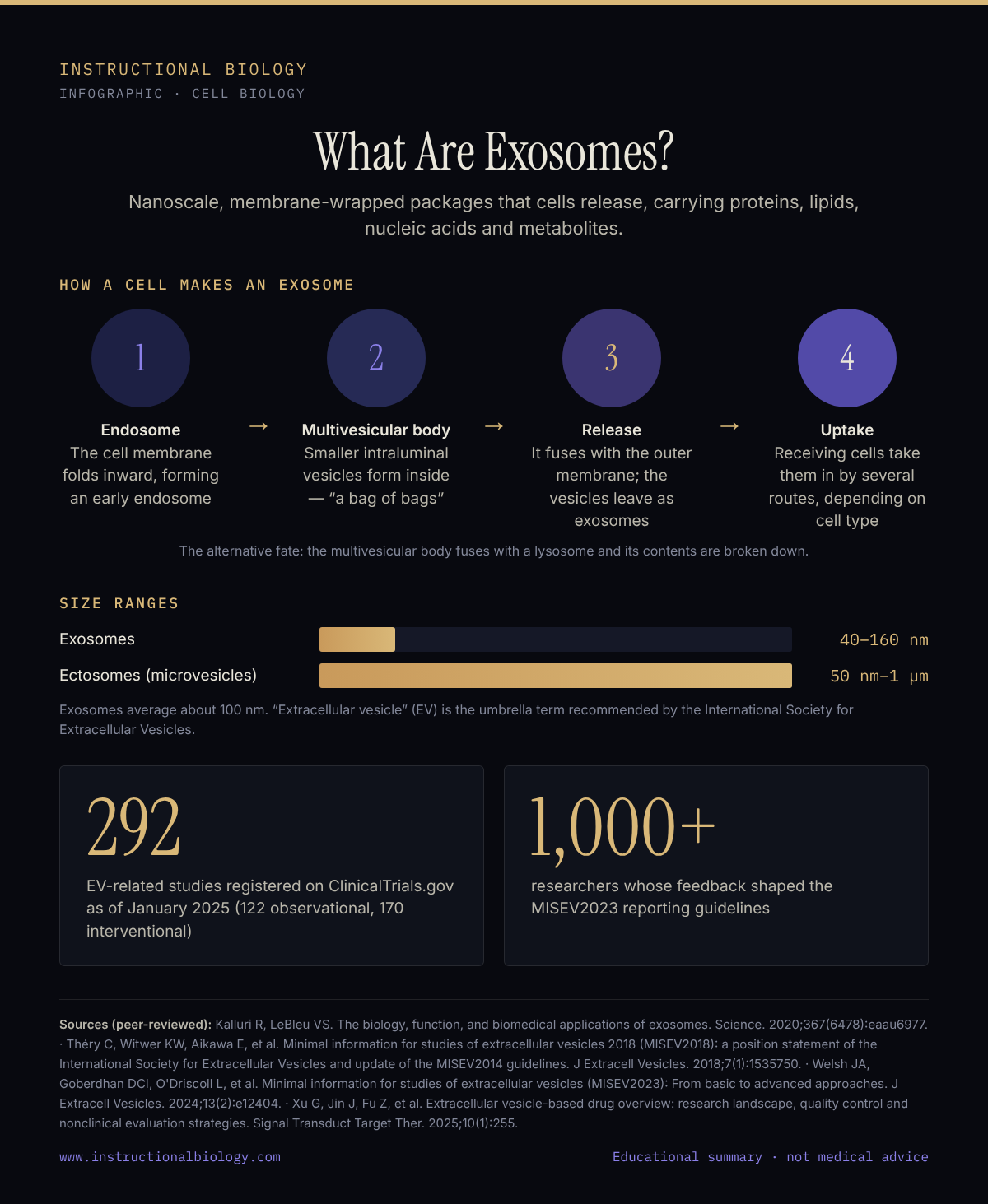
If you have searched what are exosomes, you have probably seen them described as tiny packages that cells send to one another. That is a fair starting point. Exosomes are nanoscale, membrane-wrapped particles released by cells, roughly 40 to 160 nanometres across, or about 100 nanometres on average.[1] They carry proteins, lipids, nucleic acids and metabolites that reflect the cell they came from.[1]
This explainer covers what exosomes are, how cells make and use them, why researchers are interested in them as natural drug-delivery carriers, and the open problems that still stand between the laboratory and the clinic.
What are exosomes? A plain-language definition
Exosomes belong to a larger family called extracellular vesicles, or EVs. The International Society for Extracellular Vesicles (ISEV) uses "extracellular vesicle" as the umbrella term for particles released from cells that are enclosed by a lipid bilayer and cannot replicate on their own, because they have no functional nucleus.[3]
Within that family, the name "exosome" refers to a particular origin story: vesicles that form inside the cell and are released through a compartment called the multivesicular body. Vesicles that bud directly off the cell surface are called ectosomes, also known as microvesicles or microparticles.[4] Ectosomes span a wider size range, from about 50 nanometres to 1 micrometre.[1]
Exosomes appear to be secreted by all cells and are found in all biological fluids, including blood, urine and cerebrospinal fluid.[1] Vesicle release was first described as a simple protein-recycling function, reported for the transferrin receptor as immature red blood cells (reticulocytes) mature.[1] Researchers now consider EVs an additional route for intercellular communication, allowing cells to exchange proteins, lipids and genetic material.[2]
How cells make exosomes
Exosome formation is a two-step folding process. First, the cell's outer membrane folds inward to form an early endosome, a small internal compartment. As that compartment matures, its own membrane folds inward again, pinching off many small vesicles inside it. The result is a multivesicular body: a bag filled with smaller bags, called intraluminal vesicles.[1]
From there, the multivesicular body has two possible fates. It can fuse with a lysosome, where its contents are broken down. Or it can fuse with the cell's outer membrane and release the intraluminal vesicles into the surrounding space. Once outside, those vesicles are called exosomes.[1]
A long list of molecules has been implicated in this pathway, including Rab GTPases, the ESCRT (endosomal sorting complexes required for transport) machinery, ALIX, TSG101, syndecan-1, tetraspanins, ceramides and SNARE proteins. Their precise rate-limiting roles are still being worked out.[1] Because many of these proteins also take part in other trafficking routes, such as autophagy and lysosomal pathways, experiments that switch them on or off can have indirect effects. That makes it hard to attribute a result to exosomes alone.[1]
How receiving cells take them in
Uptake is not one mechanism. Different cell types appear to use different routes: macropinocytosis has been reported in pancreatic cancer cells carrying mutant KRAS, membrane fusion in melanoma cells, and clathrin-dependent endocytosis in a rat neurosecretory cell line.[1] Much remains unknown about how vesicles are targeted to particular cells and what happens to their cargo after entry.[2]
Why exosomes interest drug-delivery researchers
Many established drug-delivery carriers are synthetic, such as liposomes. Exosomes are a natural counterpart: biological membranes that already move material between cells. Reviewers in the field have argued that EVs may offer several advantages over conventional synthetic carriers, while stressing that clinical translation remains challenging.[6]
Some of the interest comes from animal studies. In mice, injected exosomes have been reported to enter other cells efficiently and deliver functional cargo with minimal immune clearance, in contrast to liposomes.[1] RNA packaged inside exosomes may also be protected from degradation by enzymes in the blood.[1]
A landmark 2011 study showed what engineering could add. Researchers produced exosomes from self-derived dendritic cells, to reduce immune reactions, and engineered those cells to display a brain-targeting peptide (from rabies virus glycoprotein) on an exosome membrane protein called Lamp2b. They loaded the purified exosomes with short interfering RNA (siRNA) by electroporation and injected them into the bloodstream. The siRNA reached neurons, microglia and oligodendrocytes in the brain and reduced expression of BACE1, a protein studied in Alzheimer's disease, by 60% at the mRNA level and 62% at the protein level, in healthy mice.[5] That result was in animals, not people, but it helped launch the idea of exosomes as programmable carriers.
Turning exosomes into a reliable carrier depends on manufacturing as much as on biology, which the challenges below make clear.
The open challenges
Heterogeneity: one name, many particles
Any EV preparation is a mixture. EVs vary in size, origin and molecular content, and that complexity creates challenges at every stage of EV research.[4] Proving that a given vesicle came from the multivesicular body, and is therefore a true exosome, remains extraordinarily difficult without, for example, catching it in the act of release by live imaging.[3] For this reason, ISEV recommends the generic term "EV" over "exosome" unless the biogenesis pathway has been established, and notes that most of the existing "exosome" literature in fact refers to a broad population of EVs.[4]
Isolation and purity
Separating EVs from everything else in a fluid is hard. In blood, some lipoprotein particles overlap with EVs in size or density and can outnumber them by orders of magnitude; neither size-based nor density-based separation can remove all of them.[4] ISEV guidance notes that many "exosome purification" kits rely on precipitation, and so recover a mixture of extracellular particles rather than pure exosomes, or even pure EVs.[4] Every method trades yield against specificity.[4]
Scale-up manufacturing
A therapy needs consistent material in large quantities. Reviews of EV drug delivery identify loading methods, in-depth characterisation and large-scale manufacturing as critical development steps.[6] Tangential flow filtration has been used reproducibly for large-scale EV production, including for therapeutic applications.[4] Even so, a 2025 review led by authors at China's National Institutes for Food and Drug Control lists mechanistic understanding, engineering, manufacturing processes, quality control and nonclinical research as unresolved challenges.[7]
MISEV reporting standards
To improve rigour, ISEV publishes the Minimal Information for Studies of Extracellular Vesicles, or MISEV, guidelines. Versions appeared in 2014 and 2018, and the current edition, MISEV2023, compiles feedback from ISEV task forces and more than 1,000 researchers.[4] MISEV2018 cautioned that claims of exquisite and specific activities for exosomes remain difficult to support experimentally, and asked authors to show that an observed effect comes from EVs rather than co-isolated material or soluble factors.[3] For scientists reading the literature, MISEV compliance is a practical first filter.
Regulatory status
EV therapeutics are in clinical development, not routine clinical use. The 2025 review counted 292 EV-related studies registered on ClinicalTrials.gov as of January 2025, 122 observational and 170 interventional, and described EV drugs as still in clinical trials.[7] The same review reported that the WHO, the US FDA and the EMA had not issued technical guidelines for the quality control or nonclinical safety evaluation of EVs.[7] According to the authors, the FDA and EMA treat naturally derived therapeutic EVs as biological products, while engineered EVs used as delivery vehicles may be classified according to the cargo they carry.[7] Products sold as "exosomes" outside regulated clinical trials should be viewed with caution.
Where Instructional Biology fits
Our thesis is that the hard problems with exosomes are largely problems of manufacturing and measurement: defining what is in a preparation, keeping its structure intact during processing, and reporting it to MISEV standards. We are researching an exosome carrier system and the processes around it, including lower-temperature biomanufacturing designed around the question of how processing affects native biological structure. That work is research-stage, and we make no claim that it treats any condition.
Exosomes are a real and important part of how cells communicate. Whether they become dependable medicines will depend on the field solving heterogeneity, purity and scale, and on regulators and researchers agreeing on how to measure them.
Sources
- Kalluri R, LeBleu VS. The biology, function, and biomedical applications of exosomes. Science. 2020;367(6478):eaau6977. doi:10.1126/science.aau6977 · PMID 32029601
- van Niel G, D'Angelo G, Raposo G. Shedding light on the cell biology of extracellular vesicles. Nat Rev Mol Cell Biol. 2018;19(4):213-228. doi:10.1038/nrm.2017.125 · PMID 29339798
- Théry C, Witwer KW, Aikawa E, et al. Minimal information for studies of extracellular vesicles 2018 (MISEV2018): a position statement of the International Society for Extracellular Vesicles and update of the MISEV2014 guidelines. J Extracell Vesicles. 2018;7(1):1535750. doi:10.1080/20013078.2018.1535750 · PMID 30637094
- Welsh JA, Goberdhan DCI, O'Driscoll L, et al. Minimal information for studies of extracellular vesicles (MISEV2023): From basic to advanced approaches. J Extracell Vesicles. 2024;13(2):e12404. doi:10.1002/jev2.12404 · PMID 38326288
- Alvarez-Erviti L, Seow Y, Yin H, et al. Delivery of siRNA to the mouse brain by systemic injection of targeted exosomes. Nat Biotechnol. 2011;29(4):341-345. doi:10.1038/nbt.1807 · PMID 21423189
- Herrmann IK, Wood MJA, Fuhrmann G. Extracellular vesicles as a next-generation drug delivery platform. Nat Nanotechnol. 2021;16(7):748-759. doi:10.1038/s41565-021-00931-2 · PMID 34211166
- Xu G, Jin J, Fu Z, et al. Extracellular vesicle-based drug overview: research landscape, quality control and nonclinical evaluation strategies. Signal Transduct Target Ther. 2025;10(1):255. doi:10.1038/s41392-025-02312-w · PMID 40804047