 Instructional Biology
Why does heat denature proteins? The short answer: a protein works only while it holds a precise three-dimensional shape, and that shape is held together by many weak forces that heat can shake apart. Once a protein loses its shape, it usually loses its function too, and unfolded proteins tend to stick to one another and clump. That chain of events is why a cooked egg white turns solid and opaque, and it is also why biologic medicines are handled with such care.
This explainer covers what proteins and peptides are, what denaturation and aggregation mean, how temperature and other stresses unfold proteins, and how manufacturers protect fragile biologics from the factory to the patient.
Proteins and Peptides: Chains That Fold
Proteins and peptides are chains of amino acids. Peptides are the shorter chains; proteins are longer ones that fold into compact, specific structures. The sequence of amino acids carries the information that guides a chain into its working, or native, structure, and the question of exactly how a sequence dictates that structure has been studied for about half a century[1].
Folding happens fast. Proteins fold quickly because random thermal motions drive shape changes that run energetically downhill toward the native structure, a picture researchers describe as a funnel-shaped energy landscape[1].
The native shape is what lets an enzyme grip its target, a hormone fit its receptor, or an antibody recognize a virus. Change the shape and the fit is lost.
Why Heat Denatures Proteins
The same thermal motion that helps a protein find its shape can also pull it apart. A folded protein is not held together by one strong bond but by many weak, non-covalent interactions, and the overall balance between folded and unfolded states is surprisingly delicate. Most globular proteins are only marginally stable, regardless of their size or activity[2]. Modelling work suggests this marginal stability is an inherent property of proteins, arising from the sheer number of possible sequences, rather than something that must be selected for because function requires it[2].
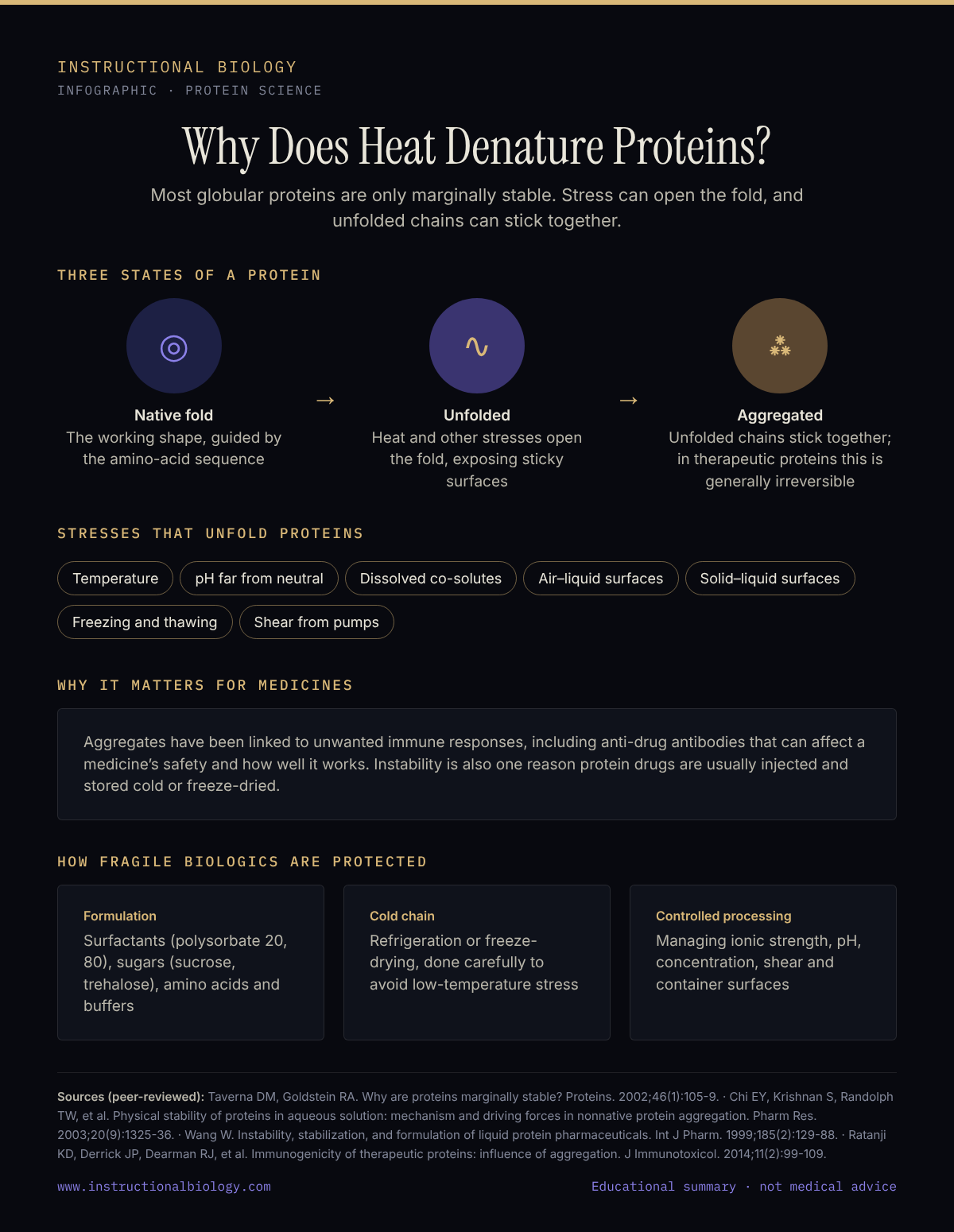
Because the margin is small, adding energy as heat can tip the balance. As temperature rises, the chain moves more vigorously, weak contacts break, and the protein shifts toward partly or fully unfolded states. This loss of native structure is what scientists call denaturation.
Heat is not the only trigger. The loss of native structure is a common response of proteins to many external stresses, including temperature, pH, dissolved co-solutes, and contact with air–liquid and solid–liquid surfaces[7]. Solution conditions such as salt type and concentration, preservatives, and surfactants also influence how proteins behave[3].
From Unfolding to Aggregation
Denaturation is often only the first step. A protein's water-avoiding (hydrophobic) parts are normally tucked inside the fold. When the fold opens, those surfaces become exposed, and current thinking is that this exposure lets unfolded or partly folded molecules stick to each other, forming aggregates[7].
Aggregation means protein molecules associating into assemblies other than their normal native arrangement. Aggregates range from small dimers up to particles large enough to see, and they can be soluble or insoluble, ordered or disordered, reversible or irreversible[7]. In therapeutic proteins, this kind of non-native aggregation is generally irreversible[7], and it can be encountered throughout a product's life, including refolding, purification, sterilization, shipping and storage[3].
Why This Matters for Biologic Medicines
Biologics are medicines made from proteins, such as antibodies, hormones and enzymes. Their structural sensitivity shapes nearly every decision about how they are made, stored and given.
Loss of Activity
A medicine that depends on a precise shape cannot do its job if the shape is gone. Protein instability is one of the major reasons protein drugs have traditionally been given by injection rather than taken by mouth like most small-molecule drugs, and they usually have to be stored cold or freeze-dried to reach an acceptable shelf life[4]. Proteins can also change chemically over time, and chemical and physical instability are interrelated[5].
Aggregation and Immunogenicity
The second concern is the immune system. The ability of protein aggregates to boost immune responses has been known for over half a century, and aggregates have been connected to antibody-mediated adverse events with early therapeutic proteins such as intravenous immune globulin and human growth hormone[6].
One proposed explanation is about pattern. Proteins arranged in highly repetitive arrays, as in some large aggregates, can strongly activate antibody-producing B cells by cross-linking their receptors[6]. Such repetitive arrays resemble the surface of a virus, which the immune system is thought to have evolved to recognize[7].
Antibodies a patient makes against a protein drug, called anti-drug antibodies, can affect its safety, how well it works, and how it behaves in the body[7]. The exact mechanisms linking aggregates to these responses are still not fully defined, and it is not yet known what type or level of aggregation is needed to cause an unwanted response[7]. That uncertainty is a strong reason to minimize aggregation in the first place.
How Manufacturers Protect Fragile Biologics
Most protein formulations contain at least a low level of aggregates[7], so limiting further damage at each stage matters. Three broad strategies stand out.
1. Formulation
The liquid a protein is dissolved in is carefully designed. Additives that help maintain native structure have been shown to reduce aggregation[7]. Common tools include:
- Surfactants such as polysorbate 20 and 80, which compete with the protein for air–liquid surfaces and protect it from unfolding there[7].
- Sugars such as sucrose and trehalose, used as stabilizers, including for freeze-dried products[7].
- Amino acids and pH buffers, used alongside surfactants to reduce aggregation in formulated products[7].
Excipients must be chosen for each protein individually, and some additives can themselves cause problems, which is why formulation requires screening and optimization[7]. Stabilization strategies span both liquid and dried states, and chemical modification and mutagenesis can also be used to make the protein itself more robust[5].
2. The Cold Chain
Keeping protein drugs cold, or freeze-drying them, is a standard way to extend shelf life[4]. Cold is not automatically safe, though. Freezing and thawing can contribute to aggregation, possibly because proteins partly unfold at the boundary between ice and liquid, and ice crystal formation can enhance unfolding[7]. Freeze-drying improves shelf life but must be done carefully, because the process itself exposes proteins to low-temperature stress[7].
3. Controlled Processing
Manufacturing exposes proteins to many stresses. Purification can involve high ionic strength, pH far from neutral and high protein concentration; pumps used during filling create shear and mechanical stress; and container surfaces such as silicone oil in syringes have been implicated in aggregation[7]. Even small process changes, such as scaling up production or adjusting a formulation, could alter a protein's immunogenic potential[7]. Changes in product manufacture and packaging that may affect aggregate formation are accordingly part of immunogenicity risk assessment[6].
A Deeper Look for Scientists
For specialists, the useful framing is kinetic as well as thermodynamic. Aggregation can occur even where the native state is thermodynamically favored and no obvious stress is applied, for example through adsorption to micro-particles or at high concentration[7]. Evidence supports a role for partially folded intermediates, and conformational stability appears to be an important factor in controlling aggregation rates[7]. Mechanistic reviews link the driving forces of non-native aggregation to temperature, pH, salt, cosolutes, preservatives and surfactants[3].
Analytics remain a challenge. No single method detects the whole range of aggregate sizes, and particles of roughly 1–100 µm are too small to see yet too large for standard size-exclusion chromatography, so a combination of techniques is required[7].
Where Instructional Biology Fits
Our research is built around the idea that preserving native structure from the start is valuable. Our thesis is that lower-temperature biomanufacturing can help keep fragile proteins and peptides closer to their native state throughout processing. We are researching the thermosensitive peptidome, the heat-sensitive proteins and peptides in biological tissue, and mapping how these molecules connect to signaling pathways through our Signaling Cascade Knowledge Graph. This work is research-stage.
The broader lesson holds for any biologic: shape is function, heat and other stresses threaten shape, and careful formulation, cold-chain handling and controlled processing are how the field protects it.
Sources
- Dill KA, MacCallum JL. The protein-folding problem, 50 years on. Science. 2012;338(6110):1042-6. doi:10.1126/science.1219021 · PMID 23180855
- Taverna DM, Goldstein RA. Why are proteins marginally stable? Proteins. 2002;46(1):105-9. doi:10.1002/prot.10016 · PMID 11746707
- Chi EY, Krishnan S, Randolph TW, et al. Physical stability of proteins in aqueous solution: mechanism and driving forces in nonnative protein aggregation. Pharm Res. 2003;20(9):1325-36. doi:10.1023/a:1025771421906 · PMID 14567625
- Wang W. Instability, stabilization, and formulation of liquid protein pharmaceuticals. Int J Pharm. 1999;185(2):129-88. doi:10.1016/s0378-5173(99)00152-0 · PMID 10460913
- Manning MC, Chou DK, Murphy BM, et al. Stability of protein pharmaceuticals: an update. Pharm Res. 2010;27(4):544-75. doi:10.1007/s11095-009-0045-6 · PMID 20143256
- Rosenberg AS. Effects of protein aggregates: an immunologic perspective. AAPS J. 2006;8(3):E501-7. doi:10.1208/aapsj080359 · PMID 17025268
- Ratanji KD, Derrick JP, Dearman RJ, et al. Immunogenicity of therapeutic proteins: influence of aggregation. J Immunotoxicol. 2014;11(2):99-109. doi:10.3109/1547691X.2013.821564 · PMID 23919460