 Instructional Biology
For most of medical history, the body has been measured in snapshots: a blood pressure reading at an appointment, a fasting glucose test, a ten-second ECG strip. Wearable health monitoring changes the sampling rate. Continuous glucose monitors, smartwatches and patch sensors now record physiology every few minutes, for weeks, while people live their normal lives. The measurements that come out of these devices are increasingly called digital biomarkers, and they are starting to change what medicine can see.
This explainer covers what a digital biomarker is, what the landmark studies found, and where the limits are.
What is a digital biomarker?
A biomarker is a characteristic that is objectively measured and evaluated as an indicator of normal biology, disease, or a response to treatment. A digital biomarker is the same idea, collected with sensors and computational tools, usually across several layers of hardware and software, and often outside the clinic, through wearable, implantable or ingestible devices.[6]
That layered structure matters. An optical sensor on the wrist does not measure heart rhythm directly. It measures tiny changes in blood volume under the skin (photoplethysmography, or PPG), and an algorithm converts that signal into a heart rate or a rhythm classification.[6] The number on the screen is only as good as each layer beneath it.
Why a single clinic snapshot misses variation
Physiology moves. Glucose rises after meals and falls overnight; heart rhythm disturbances can come and go. A single measurement captures one moment and assumes it represents the rest.
Diabetes care shows the gap clearly. Hemoglobin A1C, the standard lab test, reflects average glucose over the previous two to three months. An international consensus panel noted that it gives no information about acute highs and lows, cannot show how much glucose swings within or between days, and can be confounded by conditions such as anemia, iron deficiency and pregnancy.[3]
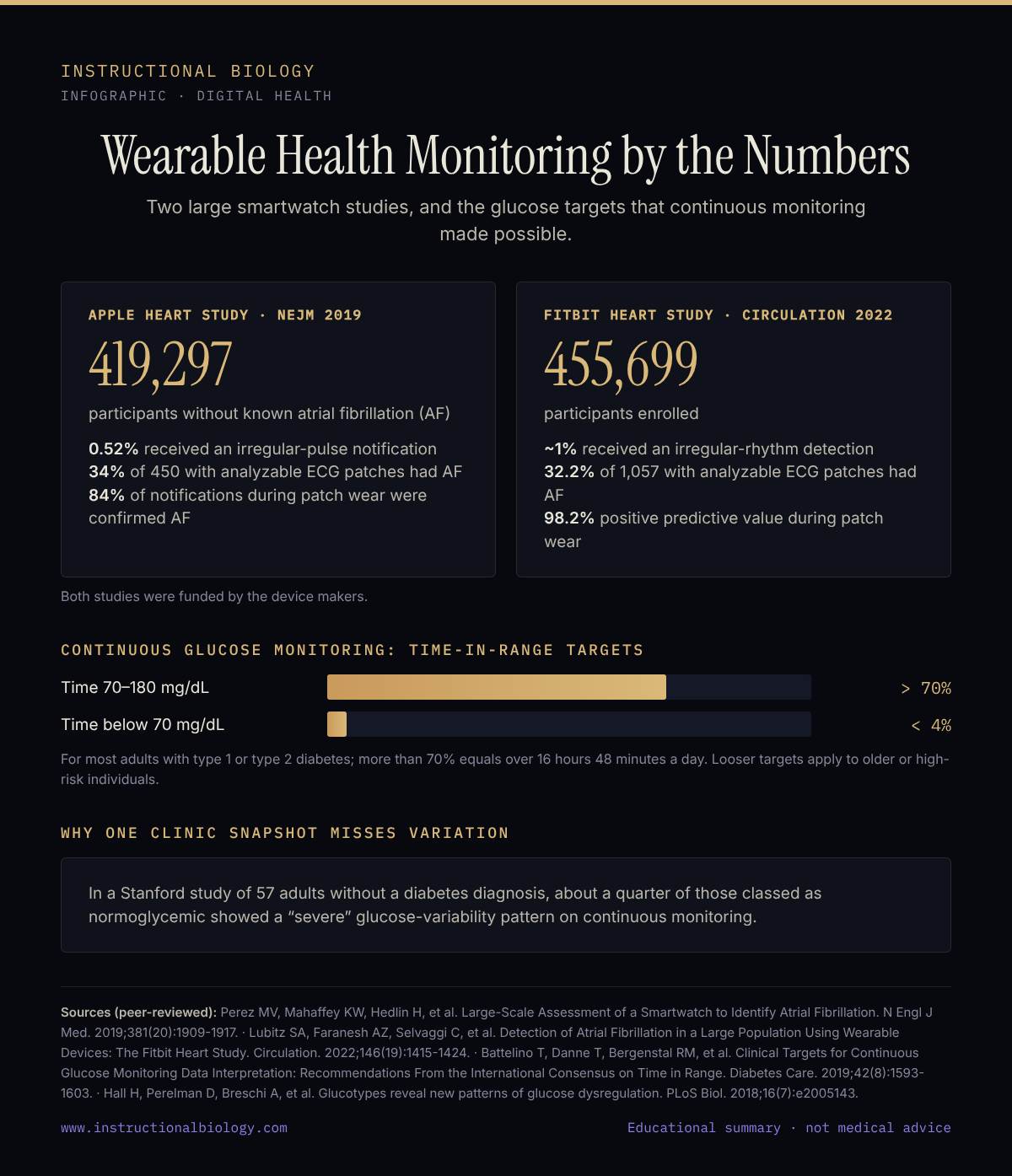
Continuous monitoring can reveal patterns that standard tests do not. In a Stanford study that gave continuous glucose monitors to 57 adults without a diabetes diagnosis, about a quarter of those classified as normoglycemic by standard measures showed a “severe” variability pattern; within that subgroup, glucose reached the prediabetic range up to 15% of the time and the diabetic range 2% of the time. Responses to identical meals also varied widely between people.[7] Average values hid individual dynamics.
Continuous glucose monitoring: from data to targets
Continuous glucose monitoring (CGM) is the most mature example of wearable health monitoring in routine care. In the DIAMOND randomized trial, 158 adults with type 1 diabetes who used insulin injections were assigned to CGM or usual care. After 24 weeks, the CGM group's A1C fell by 0.6 percentage points more than the control group's, and median time spent below 70 mg/dL was 43 minutes per day versus 80 minutes per day.[4]
Continuous data also needed a new vocabulary. In 2019 the International Consensus on Time in Range recommended that most adults with type 1 or type 2 diabetes aim to spend more than 70% of readings (more than 16 hours and 48 minutes per day) between 70 and 180 mg/dL, and less than 4% below 70 mg/dL, with looser targets for older or high-risk individuals.[3] The panel cited an analysis in which each 10-percentage-point increase in time in range corresponded to roughly a 0.5-point decrease in A1C.[3]
The panel was candid that long-term trials linking these CGM metrics to clinical outcomes had not yet been conducted, and that much of the supporting evidence was not at the highest level.[3] Time in range is a well-reasoned working target, not a settled endpoint.
Smartwatches and atrial fibrillation
Atrial fibrillation (AF) is an irregular heart rhythm that can be intermittent and silent, which makes it easy to miss in a short clinic ECG. Two large studies tested whether wrist-worn PPG sensors could flag it in everyday use.
The Apple Heart Study (Perez et al., New England Journal of Medicine, 2019) enrolled 419,297 participants without known AF. Over a median of 117 days, 2,161 people (0.52%) received an irregular pulse notification. Among the 450 who returned analyzable ECG patches, applied on average 13 days after notification, 34% had AF on the patch. When a new notification occurred while the patch was being worn, AF was confirmed on the ECG 84% of the time.[1]
The Fitbit Heart Study (Lubitz et al., Circulation, 2022) enrolled 455,699 participants. About 1% received an irregular rhythm detection. Among 1,057 with an analyzable ECG patch afterward, 32.2% had AF; when a detection occurred during patch wear, the positive predictive value for concurrent AF was 98.2%.[2]
Read carefully, these results say two things. Notifications were rare, and when one fired at the same moment an ECG was recording, it was usually right. But only about a third of notified people showed AF on a later patch, a gap that may partly reflect AF being intermittent. Both studies were designed to measure detection accuracy, not whether screening improves health outcomes. The Apple study was funded by Apple, and the Fitbit study was funded by Fitbit and included Fitbit employees among its authors.[1,2]
The limits of digital biomarkers
Accuracy depends on context
A Duke study of consumer and research-grade wrist devices found that heart-rate error during activity was, on average, 30% higher than at rest, and that devices differed from each other in how they responded to changes in activity.[8] The CGM consensus panel similarly noted sensor lag when glucose is changing quickly, along with anxiety and skin allergies as potential drawbacks.[3]
Validation is a process, not a stamp
A widely cited framework divides evaluation into three steps: verification (does the sensor capture the signal correctly?), analytical validation (does the algorithm turn that signal into an accurate metric?), and clinical validation (does the metric meaningfully identify, measure or predict a clinical state in the specified context of use?).[5] A device can pass the first two and still fail the third. Performance can also differ between patient groups, producing different false-positive and false-negative rates, and many detection algorithms are proprietary, which limits independent scrutiny.[6]
False positives have costs
When monitoring runs across hundreds of thousands of people, even a small false-alarm rate creates real follow-up work. In the Apple Heart Study, 57% of notified participants who returned a 90-day survey had contacted a health care provider outside the study.[1]
Equity and access
Green-light PPG is affected by skin tone, and researchers have raised concern that consumer wearables may be less accurate in people with darker skin, partly because validation cohorts have lacked diversity and have relied on the subjective Fitzpatrick scale.[9] The Duke study did not find a statistically significant difference in accuracy across skin tones,[8] but critics argued it included too few participants with the darkest skin tones to settle the question.[9] The honest summary is that the evidence is incomplete. Access is a separate barrier: the CGM consensus noted that the technology was not yet widely available in several regions of the world.[3]
Data privacy
Continuous monitoring produces continuous personal data. In the United States, HIPAA protections apply to health care organizations, but not when people use consumer technologies directly; data-sharing terms are then set by user agreements. Connected devices also carry cybersecurity risks.[6]
Where digital biomarkers are heading
The most consequential shift may be from measurement to feedback. Digital biomarkers are already a component of closed-loop systems, such as a continuous glucose sensor linked to an insulin pump that adjusts dosing automatically.[6] Dense data on a single person also makes "N-of-1" investigation more practical, which is central to personalizing care.[6]
At Instructional Biology, we are researching how continuous signals could one day inform closed-loop therapeutic regulation within clinician-authorized limits, and how they could feed patient digital twins that model an individual over time rather than a population average. This work is research-stage, and our thesis is that it will only be as trustworthy as the validation behind each signal. For the broader idea of treatment that adjusts to the patient, see our explainer on adaptive medicine.
Wearable health monitoring does not replace clinical judgment. It gives clinicians and patients a moving picture where they once had a photograph. Its value depends on whether that picture is accurate, validated for the person wearing the device, and handled with care.
Sources
- Perez MV, Mahaffey KW, Hedlin H, et al. Large-Scale Assessment of a Smartwatch to Identify Atrial Fibrillation. N Engl J Med. 2019;381(20):1909-1917. doi:10.1056/NEJMoa1901183 · PMID 31722151
- Lubitz SA, Faranesh AZ, Selvaggi C, et al. Detection of Atrial Fibrillation in a Large Population Using Wearable Devices: The Fitbit Heart Study. Circulation. 2022;146(19):1415-1424. doi:10.1161/CIRCULATIONAHA.122.060291 · PMID 36148649
- Battelino T, Danne T, Bergenstal RM, et al. Clinical Targets for Continuous Glucose Monitoring Data Interpretation: Recommendations From the International Consensus on Time in Range. Diabetes Care. 2019;42(8):1593-1603. doi:10.2337/dci19-0028 · PMID 31177185
- Beck RW, Riddlesworth T, Ruedy K, et al. Effect of Continuous Glucose Monitoring on Glycemic Control in Adults With Type 1 Diabetes Using Insulin Injections: The DIAMOND Randomized Clinical Trial. JAMA. 2017;317(4):371-378. doi:10.1001/jama.2016.19975 · PMID 28118453
- Goldsack JC, Coravos A, Bakker JP, et al. Verification, analytical validation, and clinical validation (V3): the foundation of determining fit-for-purpose for Biometric Monitoring Technologies (BioMeTs). NPJ Digit Med. 2020;3:55. doi:10.1038/s41746-020-0260-4 · PMID 32337371
- Coravos A, Khozin S, Mandl KD. Developing and adopting safe and effective digital biomarkers to improve patient outcomes. NPJ Digit Med. 2019;2:14. doi:10.1038/s41746-019-0090-4 · PMID 30868107
- Hall H, Perelman D, Breschi A, et al. Glucotypes reveal new patterns of glucose dysregulation. PLoS Biol. 2018;16(7):e2005143. doi:10.1371/journal.pbio.2005143 · PMID 30040822
- Bent B, Goldstein BA, Kibbe WA, Dunn JP. Investigating sources of inaccuracy in wearable optical heart rate sensors. NPJ Digit Med. 2020;3:18. doi:10.1038/s41746-020-0226-6 · PMID 32047863
- Colvonen PJ, DeYoung PN, Bosompra NA, Owens RL. Limiting racial disparities and bias for wearable devices in health science research. Sleep. 2020;43(10):zsaa159. doi:10.1093/sleep/zsaa159 · PMID 32893865