 Instructional Biology
Why do drugs fail clinical trials so often? The short answer is that most candidates that reach human testing turn out to be not effective enough, not safe enough, or not worth continuing. One of the largest peer-reviewed analyses of drug development success rates, covering 406,038 trial entries for 21,143 compounds between 2000 and 2015, estimated that only 13.8% of drug development programs that enter Phase 1 go on to approval.[1] This article walks through what that number means, the reasons for failure, the cost, and how researchers are trying to improve the odds.
What is the drug development success rate?
A new medicine normally passes through three phases of clinical testing before regulators decide on approval. Phase 1 looks mainly at safety, Phase 2 at whether the drug works for a given condition, and Phase 3 at efficacy in larger populations and against alternatives.[1]
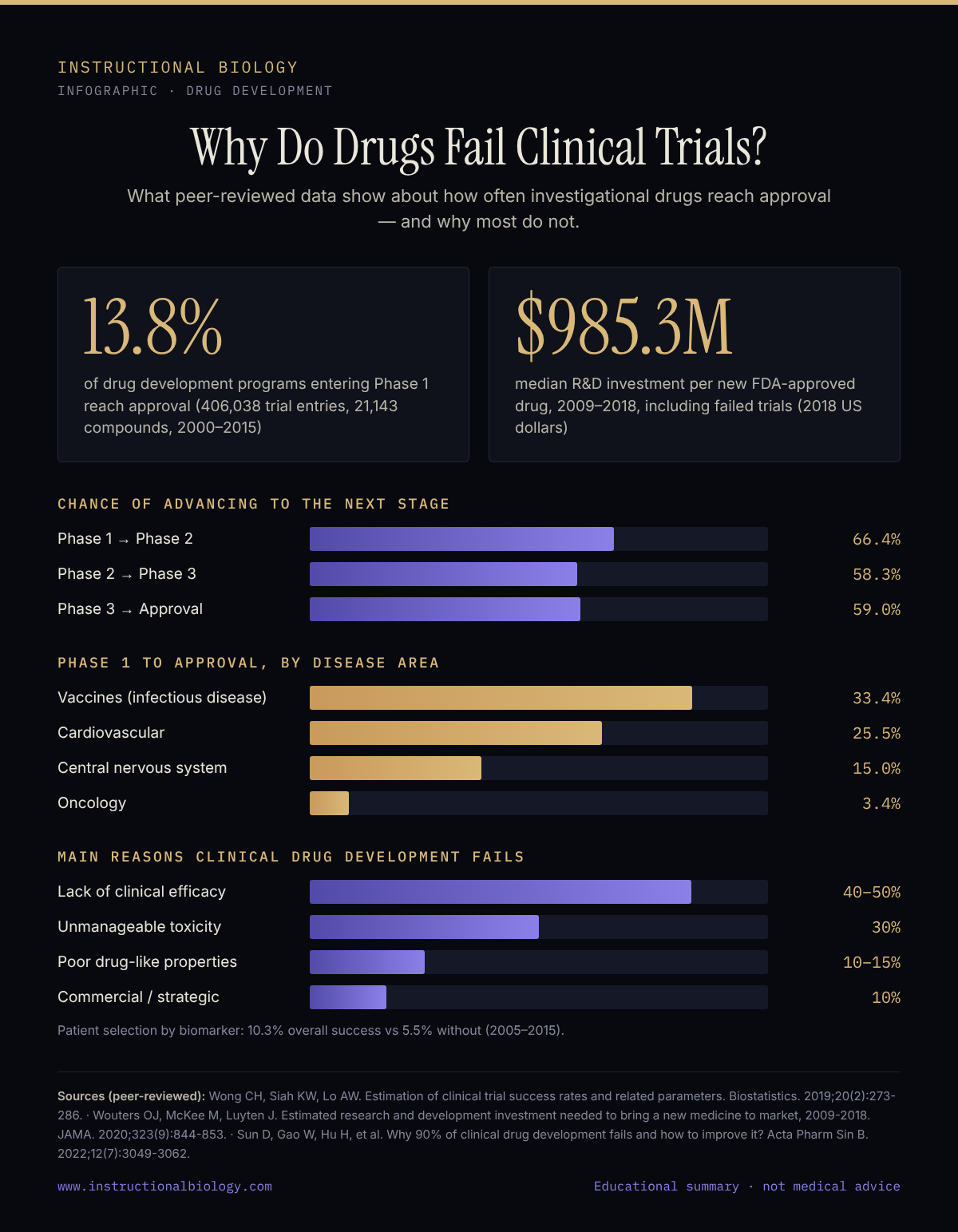
Wong, Siah and Lo traced each drug-indication pair through those phases. In their industry-sponsored data, 66.4% of programs advanced from Phase 1 to Phase 2, 58.3% from Phase 2 to Phase 3, and 59.0% from Phase 3 to approval, giving the overall 13.8%.[1] Each step looks survivable on its own. Multiplied together, the attrition is steep.
The figure depends on method. When the same data were analyzed phase by phase, the way most earlier studies did it, the overall estimate was 6.9%, and earlier industry-database studies had reported 9.6% and 10.4%.[1] A widely cited review rounds the picture to roughly nine in ten clinical candidates failing, with an overall success rate of 10% to 15%.[3] The honest summary is a range, not a single number.
It varies a lot by disease area
Success rates are far from uniform. In the Wong analysis, the probability of moving from Phase 1 to approval was 3.4% for oncology and 33.4% for vaccines against infectious disease, with cardiovascular at 25.5% and central nervous system programs at 15.0%.[1] The median time spent in clinical trials was 5.9 to 7.2 years for non-oncology areas but 13.1 years for oncology.[1] Median trial durations were 1.6, 2.9 and 3.8 years for Phases 1, 2 and 3.[1]
The authors also found that the overall success rate fell from 11.2% in 2005 to 5.2% in 2013 before turning upward, a trend they measured with rolling three-year windows.[1]
Why do drugs fail clinical trials? The four main reasons
Sun and colleagues, citing analyses of clinical trial data from 2010 to 2017, attributed clinical failures to four broad causes:[3]
- Lack of clinical efficacy: 40% to 50%. The drug does not produce a meaningful benefit in patients.
- Unmanageable toxicity: 30%. Side effects outweigh the benefit at the doses needed.
- Poor drug-like properties: 10% to 15%. Problems with how the drug is absorbed, distributed, metabolized or cleared.
- Lack of commercial need or poor strategic planning: 10%. The program is stopped for business or portfolio reasons.
These categories overlap in practice. A drug that cannot reach its target tissue at a safe dose may be recorded as an efficacy failure or a safety failure depending on how the trial ended. Sun and colleagues argue that drug optimization has focused heavily on potency and specificity against a target while paying too little attention to how much drug actually reaches diseased versus healthy tissue, which in turn affects the balance between dose, efficacy and toxicity.[3]
The translation problem: from animals to people
Many failures trace back to the step between preclinical models and humans. Sun and colleagues note that biological differences between cell lines, animal disease models and human disease make true validation of a new target difficult before a drug is actually tested in patients.[3]
Safety prediction has its own limits. In a review in JACC: Basic to Translational Science, Van Norman summarized evidence that animal toxicity testing is an inconsistent guide to human toxicity. She cites a review of 221 animal experiments that found agreement with human studies only 50% of the time, and work by van Meer and colleagues showing that of 93 serious post-marketing adverse outcomes, only 19% had been identified in preclinical animal studies.[4] Animal studies still matter, and regulators generally still require them, but these data help explain why safety problems often surface only in human trials.[4]
What it costs: failure is built into the price
Failed programs are paid for by the ones that succeed. Wouters, McKee and Luyten analyzed new drugs and biologics approved by the US Food and Drug Administration from 2009 to 2018. Spending data were available for 63 of the 355 products approved in that period. After accounting for the costs of failed trials and capitalizing at 10.5% per year, they estimated a median research and development investment of $985.3 million and a mean of $1,335.9 million per new drug, in 2018 US dollars.[2]
Medians by therapeutic area ranged from $765.9 million for nervous system agents to $2,771.6 million for antineoplastic and immunomodulating agents.[2] The authors caution that the available data came mainly from smaller firms, orphan drugs and certain therapeutic areas, and that results shifted with different assumptions about success rates and cost of capital.[2] Because the cost of failures is folded into the cost of each success, attrition rates matter to companies facing revenue loss from expiring exclusivity, discussed in our piece on the pharmaceutical patent cliff.
How researchers are trying to improve the odds
Better target selection and validation
Picking the right biological target is the first lever. A team at GlaxoSmithKline and collaborators found that the share of drug mechanisms with direct human genetic support rose from 2.0% at the preclinical stage to 8.2% among approved drugs, and estimated that selecting genetically supported targets could double the success rate in clinical development.[5]
AstraZeneca's review of its own small-molecule projects from 2005 to 2010 led to a framework built on five technical determinants of success: the right target, the right patient, the right tissue, the right safety and the right commercial potential, supported by a sixth factor, the right culture for decision-making.[6] The authors were careful to say it was too early to show whether the framework had improved productivity.[6]
Biomarkers to choose the right patients
Matching a drug to the patients most likely to respond can change results. In the Wong analysis of trials from 2005 to 2015, programs that used biomarkers to select patients had an overall success rate of 10.3% compared with 5.5% for programs that did not.[1] Most of those biomarker trials were in oncology, and the authors warn against over-interpreting results for other areas because of small sample sizes. When the definition was widened to include trials evaluating new biomarkers, the difference was no longer significant.[1]
Modeling and in silico approaches
Quantitative models are increasingly used to inform decisions before and during trials. A review by US Food and Drug Administration scientists describes how model-informed drug development is applied to clinical trial design, including dose selection and optimization, and to regulatory questions such as evidence of effectiveness.[7] Van Norman lists in silico tests and computer modeling among the alternatives to animal testing, while noting that a comprehensive study of their accuracy compared with animal toxicity testing had not been published.[4] For a broader look at these methods, see our explainer on in silico drug development.
None of these tools removes biology's uncertainty. They aim to move failures earlier, when they cost less, and to concentrate resources on candidates with stronger evidence behind them.
Where Instructional Biology fits
Our thesis is that a large part of clinical failure starts with incomplete knowledge of how signaling pathways connect across tissues. We are researching a signaling cascade knowledge graph and reasoning system intended to organize published evidence about those connections. This work is research-stage, and it has not been shown to change clinical trial outcomes.
The bottom line
The best peer-reviewed estimates put the drug development success rate from Phase 1 to approval at roughly 7% to 14% depending on method, with wide differences between disease areas.[1] Most failures come from insufficient efficacy or unmanageable toxicity,[3] and the cost of those failures is built into the estimated median research and development investment of $985.3 million to bring a new medicine to market.[2] Better targets, better patient selection and better models each offer measurable but partial gains.
Sources
- Wong CH, Siah KW, Lo AW. Estimation of clinical trial success rates and related parameters. Biostatistics. 2019;20(2):273-286. doi:10.1093/biostatistics/kxx069 · PMID 29394327
- Wouters OJ, McKee M, Luyten J. Estimated research and development investment needed to bring a new medicine to market, 2009-2018. JAMA. 2020;323(9):844-853. doi:10.1001/jama.2020.1166 · PMID 32125404
- Sun D, Gao W, Hu H, et al. Why 90% of clinical drug development fails and how to improve it? Acta Pharm Sin B. 2022;12(7):3049-3062. doi:10.1016/j.apsb.2022.02.002 · PMID 35865092
- Van Norman GA. Limitations of animal studies for predicting toxicity in clinical trials: is it time to rethink our current approach? JACC Basic Transl Sci. 2019;4(7):845-854. doi:10.1016/j.jacbts.2019.10.008 · PMID 31998852
- Nelson MR, Tipney H, Painter JL, et al. The support of human genetic evidence for approved drug indications. Nat Genet. 2015;47(8):856-860. doi:10.1038/ng.3314 · PMID 26121088
- Cook D, Brown D, Alexander R, et al. Lessons learned from the fate of AstraZeneca's drug pipeline: a five-dimensional framework. Nat Rev Drug Discov. 2014;13(6):419-431. doi:10.1038/nrd4309 · PMID 24833294
- Madabushi R, Seo P, Zhao L, et al. Review: role of model-informed drug development approaches in the lifecycle of drug development and regulatory decision-making. Pharm Res. 2022;39(8):1669-1680. doi:10.1007/s11095-022-03288-w · PMID 35552984