 Instructional Biology
Opioids are among the pain medicines most commonly used in clinical practice [1], and they carry a heavy cost: a 2025 study in the American Journal of Preventive Medicine reports 79,358 fatal opioid-involved overdoses in 2023 [2]. VPE-3 (POEF) is our discovery-stage program built on a different question from making a stronger opioid: can the brain's own response to opioids be strengthened, so that less opioid gives the same opioid pain relief? In rats, POEF did not relieve pain on its own. It strengthened the pain relief that opioids produce [3].
This page sets out what the peer-reviewed rat studies found and what has not been tested yet.
How the brain responds to opioids
Opioids work through opioid receptors in the nervous system. There are three classical opioid receptors, known as mu, delta and kappa, and opioid drugs can switch them on, block them, or partly switch them on [1]. All three belong to the family of G-protein coupled receptors, and when an opioid switches one on, the cell becomes hyperpolarized, which makes a nerve cell less likely to fire [1]. Most opioid pain medicines used in clinics switch on mu receptors in the central and peripheral nervous system to produce pain relief [1].
The body also runs its own opioid system. In rats, natural opioid-based pain relief is evident at the end of pregnancy and during delivery [3]. Opioid pain relief, in other words, is not only something a drug delivers. It is a system the brain already uses, and the studies below show that its strength can be changed.
What is VPE-3 (POEF)?
POEF is the name researchers at the University at Buffalo gave to a naturally occurring factor that, when eaten, enhances opioid-mediated pain relief in rats [3]. Their 2004 paper calls POEF "presumably the active substance" behind these effects [4]. Its effects have been measured in animals; the molecule itself has not yet been isolated and characterized [5]. VPE-3 is the name of our program on this factor.
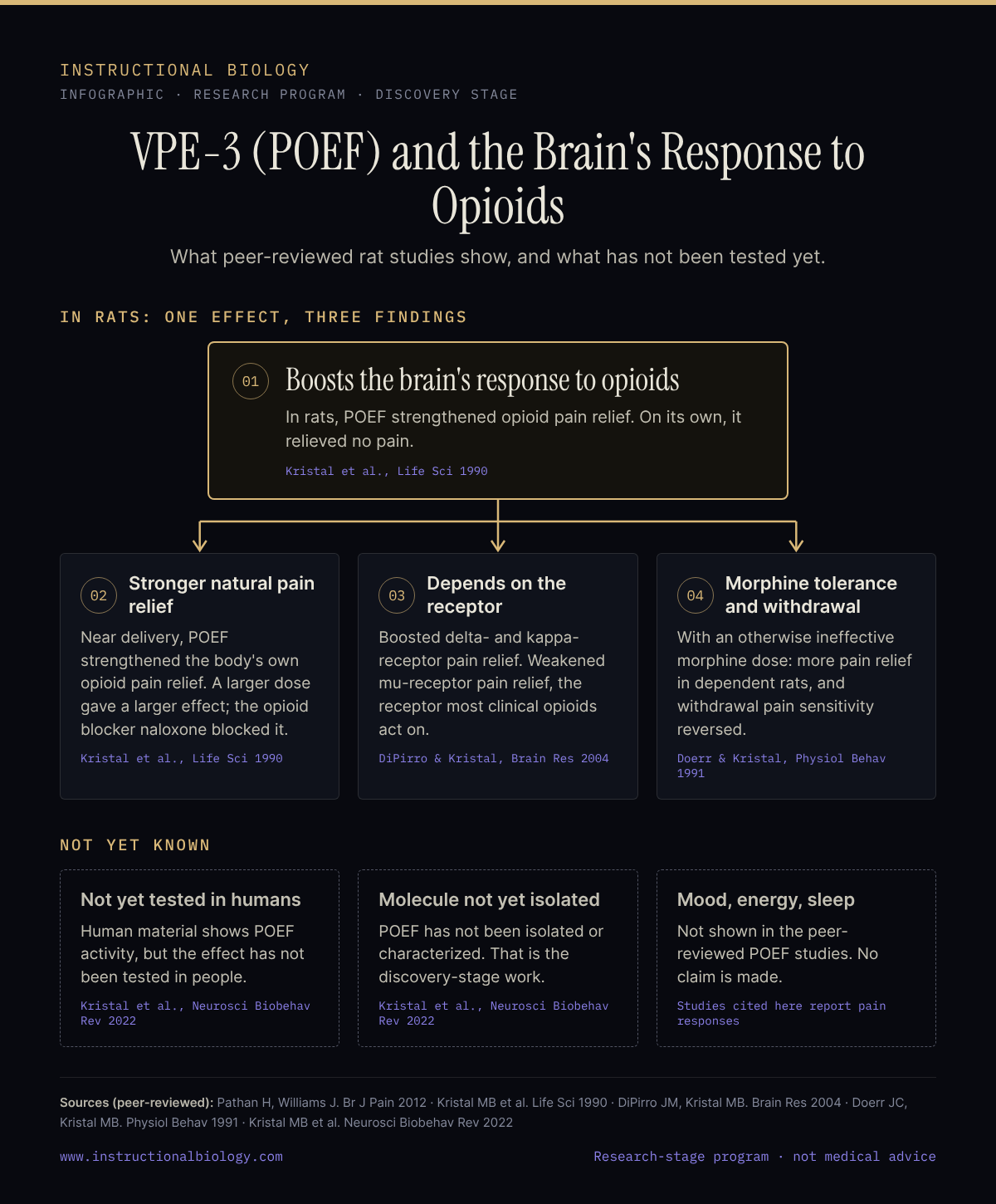
What the rat studies found about opioid pain relief
Three studies from the same research group, published between 1990 and 2004, carry most of the evidence. Each used a different test, so together they describe POEF's effects in specific experimental settings rather than one simple rule.
It strengthens opioid pain relief but is not a painkiller by itself. In rats already experiencing opioid-mediated pain relief, eating POEF enhanced it; in rats that were not, it produced no pain relief [3]. In a 1990 study in Life Sciences, rats given POEF-containing material just before delivery showed stronger natural pain relief. A larger dose gave a larger effect, and the opioid blocker naloxone blocked the enhancement [3]. That last result matters: it shows the effect runs through the opioid system.
Its effect depends on the receptor. In a 2004 study in Brain Research, adult female rats ate POEF-containing material or a control. They then received, by injection into the brain, a drug that switches on only one type of opioid receptor, and were tested on a 52 °C hotplate [4]. POEF strengthened delta- and kappa-receptor pain relief but weakened mu-receptor pain relief [4]. The authors described POEF's action as "both opioid receptor-specific and complex," and as important information for its possible use alongside opioids in pain management [4]. Because most clinical opioid pain medicines act on mu receptors [1], this pattern raises a central question for any future therapy: which receptors it would be paired with.
It enhanced morphine pain relief during tolerance and withdrawal. In a 1991 study in Physiology & Behavior, rats received daily morphine injections until they became dependent [6]. After dependence was established, eating POEF-containing material together with a morphine dose that was otherwise ineffective enhanced pain relief. The same combination reversed the heightened pain sensitivity, called hyperalgesia, seen during withdrawal from morphine [6].
The published summaries of these studies report pain responses. We have not seen peer-reviewed evidence that POEF changes mood, energy or sleep, and we make no such claim.
What is not known yet
- Whether it works in people. Human material shows POEF activity, but the POEF effect has not yet been tested in humans [5].
- What it is. The molecule has not been isolated or characterized. The 2022 review by the same research group discusses what doing so could mean for the management of pain and addiction [5].
- Which receptors matter in humans. In rats, POEF boosted delta- and kappa-receptor pain relief and weakened mu-receptor pain relief [4]. How that pattern carries over to people, and to the opioid medicines doctors prescribe, is unknown.
- Safety, dose and delivery in people. None of these can be known yet, because the effect has not been tested in humans [5].
Why strengthening opioid pain relief is worth studying
If a factor could make a smaller opioid dose work, as an otherwise ineffective morphine dose did in dependent rats [6], it might one day let clinicians reach the same pain relief with less opioid. That is a hypothesis, not a finding in people. The researchers who have studied POEF most closely point the same way: they describe its possible use alongside opioids in pain management [4], and possible implications for managing both pain and addiction [5]. Given the scale of opioid-involved overdose deaths [2], the question deserves careful, well-controlled study.
Our research direction
Our thesis is that the best chance of isolating an unidentified signaling factor with its activity intact comes from gentle methods, which is why our lower-temperature, native-state biomanufacturing research matters to this program. For VPE-3, the discovery-stage questions come in order: isolate the factor, define its structure, map how it acts at each opioid receptor, and only then test, in properly designed studies, whether it lowers the opioid dose needed for pain relief. VPE-3 is a research program at the Discovery stage. It is not a product, and it has not been tested in people.
Sources
- Pathan H, Williams J. Br J Pain. 2012;6(1):11-16. doi:10.1177/2049463712438493 · PMID 26516461
- Gardner SD, Marziali ME, Kreski NT, et al. Am J Prev Med. 2025;70(6):108207. doi:10.1016/j.amepre.2025.108207 · PMID 41338535
- Kristal MB, Thompson AC, Abbott P, et al. Life Sci. 1990;46(10):693-698. doi:10.1016/0024-3205(90)90074-2 · PMID 2314190
- DiPirro JM, Kristal MB. Brain Res. 2004;1014(1-2):22-33. doi:10.1016/j.brainres.2004.04.006 · PMID 15212988
- Kristal MB, DiPirro JM, Thompson AC, Wood TD. Neurosci Biobehav Rev. 2022;145:104992. doi:10.1016/j.neubiorev.2022.104992 · PMID 36509207
- Doerr JC, Kristal MB. Physiol Behav. 1991;50(3):633-635. doi:10.1016/0031-9384(91)90558-6 · PMID 1801021