 Instructional Biology
ISRS-ML is Instructional Biology's non-thermal optical pathogen-reduction system. It is designed to reduce pathogen load in complex biological material without heat, and it is licensable as a standalone apparatus to blood banks, plasma processors and biologics manufacturers.
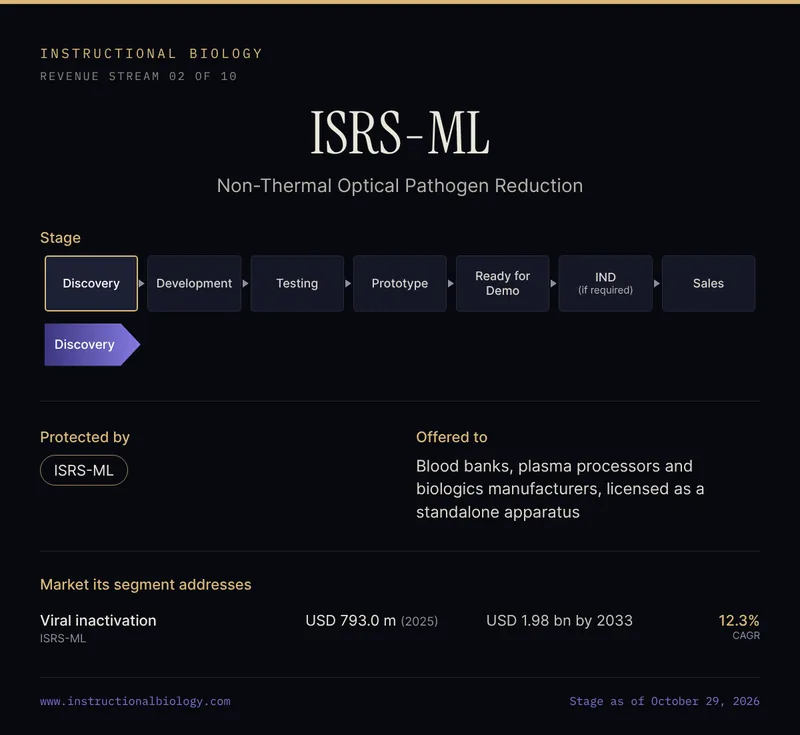
Where It Stands
ISRS-ML is at Discovery, the first of the seven stages on Our Pipeline: Discovery, Development, Testing, Prototype, Ready for Demo, IND (if required) and Sales.
How It Works
For decades the default way to make biological material safe has been heat: reliable at killing pathogens, and indifferent to the delicate three-dimensional folds that give complex signaling peptides their function. ISRS-ML uses a different physical mechanism, ultrashort-pulse optical clearance, in the visible-to-near-infrared range at femtosecond-to-sub-picosecond pulse widths, tuned below the threshold that damages protein structure. Instead of depositing heat, it delivers a sharp mechanical impulse tuned to a pathogen's own structural vibrational modes, weakening the bonds that hold it together.
The physics is not new. Laser-driven, non-thermal pathogen inactivation through this general mechanism has been documented in peer-reviewed literature since 2007, and extended since then across multiple virus families. How Lasers Kill Viruses walks through that research. What is new is the application: a licensable apparatus built to work alongside native-state processing.
Why It Pairs With MHFBP
We treat pathogen safety and structural preservation as two engineering problems, each with its own tool. MHFBP governs thermal and chemical exposure to preserve native structure, and ISRS-ML handles safety through a mechanism that does not compete with that goal. Safety without structural integrity is a wasted process, and structural integrity without safety is not a usable product.
The Segment That Protects It
ISRS-ML is protected by the ISRS-ML segment of our IP portfolio. The system is claimed in U.S. Patent Application No. 19/793,487 (claim 7). The claims are pending and have not been examined.
The Market Behind Its Segment
Each segment of our IP portfolio addresses a market that independent research firms already measure. The table gives that market's latest published size, its forecast and its compound annual growth rate (CAGR), from the same sources as Ten Revenue Streams.
| Market and segment | Size | Forecast | CAGR |
|---|---|---|---|
| Viral inactivation [1] ISRS-ML | USD 793.0 m (2025) | USD 1.98 bn by 2033 | 12.3% |
These are estimates of whole markets, not Instructional Biology revenue or forecasts.
For partnership or licensing conversations about ISRS-ML, see Partnerships and Licensing.
Sources
- Grand View Research, viral inactivation market. grandviewresearch.com