 Instructional Biology
ASAP, the Advanced Science AI Platform, is Instructional Biology's discovery engine. It reasons over the Signaling Cascade Knowledge Graph, a hyperbolic map of peptides, receptors, signaling cascades, master regulators, disease states and outcomes, and the typed, directional relationships between them. We offer ASAP to pharma and biotech partners in three forms: subscriptions, discovery partnerships and platform licenses.
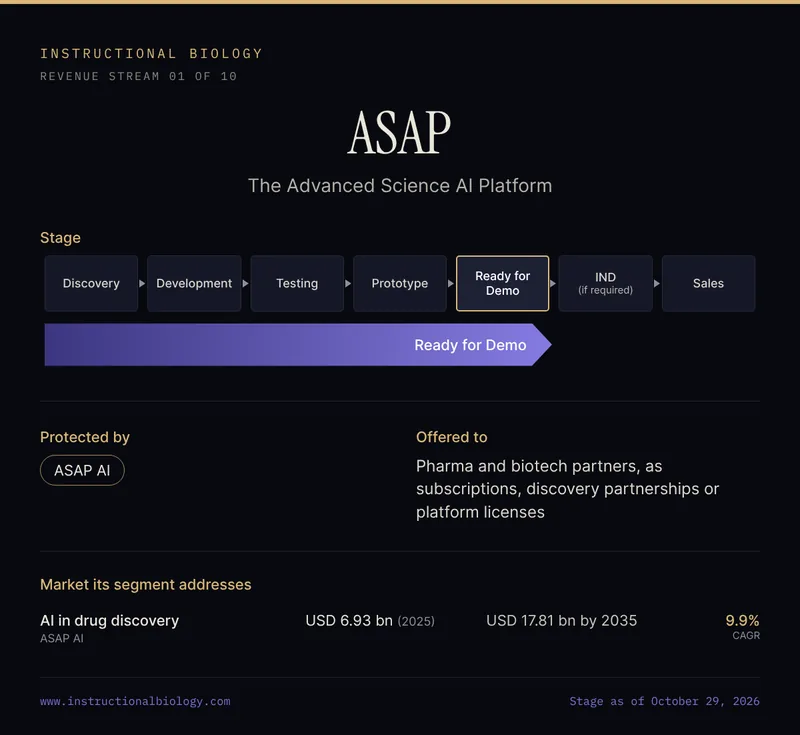
Where It Stands
ASAP is at Ready for Demo, the fifth of the seven stages on Our Pipeline: Discovery, Development, Testing, Prototype, Ready for Demo, IND (if required) and Sales. Of our ten revenue streams, only our OTC products, already at Sales, are further along.
What It Does
ASAP takes a large, messy body of biological evidence and organizes it into a structure a computational model can reason over explicitly, instead of holding it informally in one researcher's working memory. Two design choices make that possible. The graph is embedded in hyperbolic space, a geometry that accommodates the exponential branching of a real biological hierarchy without running out of room at the periphery the way flat layouts do. And the reasoning layer uses graph neural network message passing that tracks polarity, so a peptide that activates a pathway and one that suppresses it are never collapsed into one ambiguous signal.
Given a biological question, ASAP returns a ranked set of hypotheses: connections between a signaling molecule and a possible outcome, weighted by how well the connecting evidence supports them and how central the intermediate biology is to the wider network. Every output traces back to the evidence behind it and is reviewed by a person before it goes anywhere near a laboratory bench. ASAP does not produce a diagnosis, a treatment decision or a claim of efficacy. The Poincaré Explorer shows the geometry live.
Why It Sits at the Center
ASAP is the operating system behind everything else we build: the ISRS-ML module, the retrofit bioreactor skids, the MET-APFS targeting system and the personalized-medicine digital twin. Every safety stop runs in hardware on its own, so if ASAP ever goes silent, the process stops safely. ASAP also powers a second revenue stream, In-Silico Tox & Clinical, where it works together with the digital twin.
The Segment That Protects It
ASAP is protected by the ASAP AI segment of our IP portfolio. The system is claimed in U.S. Patent Application No. 19/793,487 (claim 18). The claims are pending and have not been examined.
The Market Behind Its Segment
Each segment of our IP portfolio addresses a market that independent research firms already measure. The table gives that market's latest published size, its forecast and its compound annual growth rate (CAGR), from the same sources as Ten Revenue Streams.
| Market and segment | Size | Forecast | CAGR |
|---|---|---|---|
| AI in drug discovery [1] ASAP AI | USD 6.93 bn (2025) | USD 17.81 bn by 2035 | 9.9% |
These are estimates of whole markets, not Instructional Biology revenue or forecasts.
For partnership or licensing conversations about ASAP, see Partnerships and Licensing.
Sources
- Precedence Research, AI in drug discovery market. precedenceresearch.com