 Instructional Biology
Therapeutics & Vanguard Assets are Instructional Biology's drug candidates for disease indications. Each candidate is protected four ways: by its indication, its composition, its carrier and its release certification. The first is VPE-3.
Where It Stands
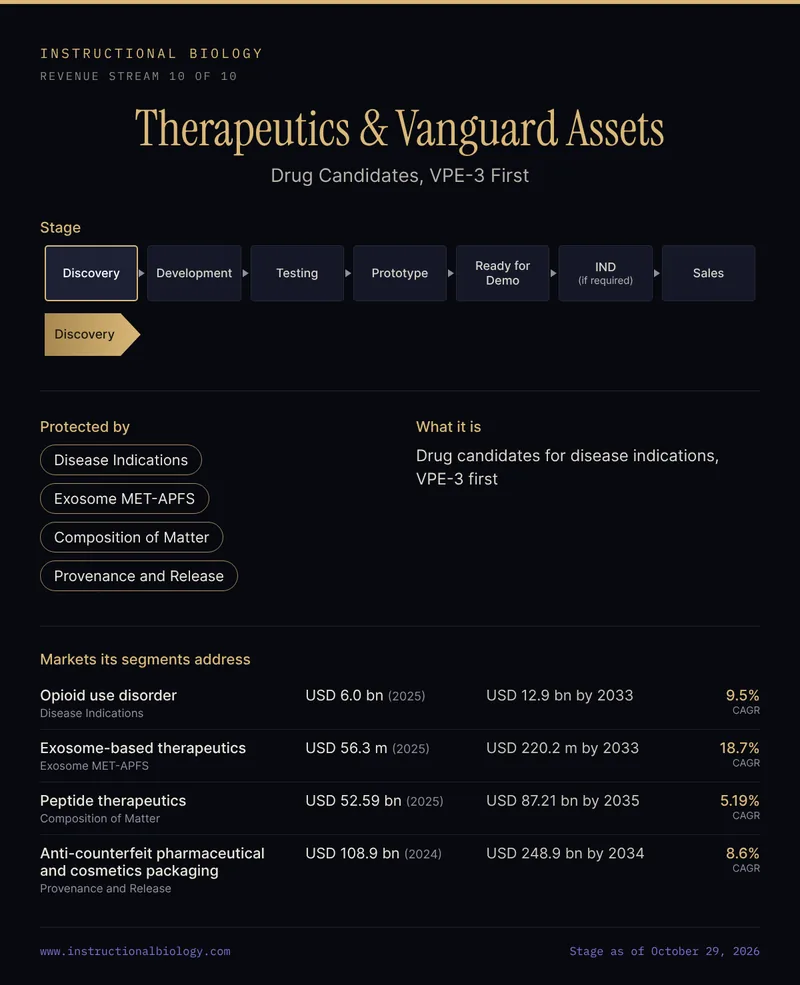
Therapeutics & Vanguard Assets is at Discovery, the first of the seven stages on Our Pipeline: Discovery, Development, Testing, Prototype, Ready for Demo, IND (if required) and Sales. VPE-3 has not been tested in people.
VPE-3 First
Opioids are among the pain medicines most commonly used in clinical practice [1], and they carry a heavy cost: a 2025 study in the American Journal of Preventive Medicine reports 79,358 fatal opioid-involved overdoses in 2023 [2]. VPE-3 (POEF) asks a different question from making a stronger opioid: can the brain's own response to opioids be strengthened, so that less opioid gives the same pain relief? In rats, POEF did not relieve pain on its own; it strengthened the pain relief that opioids produce [3].
The molecule has not yet been isolated or characterized, and its effect has not been tested in people [4]. So the program's questions come in order: isolate the factor, define its structure, map how it acts at each opioid receptor, and only then test, in properly designed studies, whether it lowers the opioid dose needed for pain relief. VPE-3 (POEF) and Opioid Pain Relief sets out what the rat studies found.
The Carrier
A biologically active peptide that never reaches its target intact is an interesting molecule, not a therapeutic. Our carrier (exosome) system, MET-APFS, builds engineered delivery vesicles modeled on the body's own extracellular-vesicle transport, configured per individual from the same evidence graph ASAP reasons over. The carrier (exosome) manufacturing system page explains why the carrier matters as much as the cargo.
The Segments That Protect It
Four segments of our IP portfolio protect this stream: Disease Indications, Exosome MET-APFS, Composition of Matter, and Provenance and Release. The MET-APFS carrier loader is claimed in U.S. Patent Application No. 19/793,487 (claim 13). The claims are pending and have not been examined.
The Markets Behind Its Segments
Each segment of our IP portfolio addresses a market that independent research firms already measure. The table gives each market's latest published size, its forecast and its compound annual growth rate (CAGR), from the same sources as Ten Revenue Streams.
| Market and segment | Size | Forecast | CAGR |
|---|---|---|---|
| Opioid use disorder [5] Disease Indications | USD 6.0 bn (2025) | USD 12.9 bn by 2033 | 9.5% |
| Exosome-based therapeutics [6] Exosome MET-APFS | USD 56.3 m (2025) | USD 220.2 m by 2033 | 18.7% |
| Peptide therapeutics [7] Composition of Matter | USD 52.59 bn (2025) | USD 87.21 bn by 2035 | 5.19% |
| Anti-counterfeit pharmaceutical and cosmetics packaging [8] Provenance and Release | USD 108.9 bn (2024) | USD 248.9 bn by 2034 | 8.6% |
These are estimates of whole markets, not Instructional Biology revenue or forecasts.
For partnership or licensing conversations about Therapeutics & Vanguard Assets, see Partnerships and Licensing.
Sources
- Pathan H, Williams J. Br J Pain. 2012;6(1):11-16. doi:10.1177/2049463712438493 · PMID 26516461
- Gardner SD, Marziali ME, Kreski NT, et al. Am J Prev Med. 2025;70(6):108207. doi:10.1016/j.amepre.2025.108207 · PMID 41338535
- Kristal MB, Thompson AC, Abbott P, et al. Life Sci. 1990;46(10):693-698. doi:10.1016/0024-3205(90)90074-2 · PMID 2314190
- Kristal MB, DiPirro JM, Thompson AC, Wood TD. Neurosci Biobehav Rev. 2022;145:104992. doi:10.1016/j.neubiorev.2022.104992 · PMID 36509207
- Grand View Research, opioid use disorder market. grandviewresearch.com
- Grand View Research, exosome-based therapeutics market. grandviewresearch.com
- Precedence Research, peptide therapeutics market. precedenceresearch.com
- Global Insight Services, anti-counterfeit pharmaceutical and cosmetics packaging market. giiresearch.com