 Instructional Biology
In-Silico Tox & Clinical gives drug developers computational toxicity screening and virtual-cohort testing before a study begins. It combines two Instructional Biology systems: ASAP, which ranks what is worth testing, and the digital twin, which models how an individual responds.
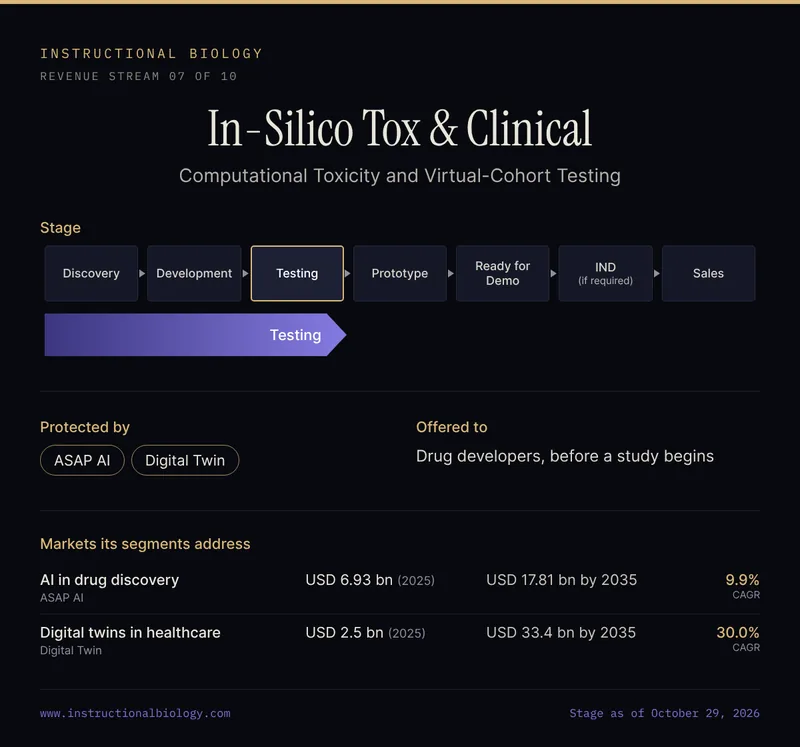
Where It Stands
In-Silico Tox & Clinical is at Testing, the third of the seven stages on Our Pipeline: Discovery, Development, Testing, Prototype, Ready for Demo, IND (if required) and Sales.
What It Does
Every wet-lab experiment costs reagents, animal or tissue subjects and weeks of a researcher's time, and a wrong hypothesis spends all of it to learn what did not work. In silico, literally "in silicon", means running that first pass inside a computational model. It does not replace the lab. It changes what reaches the lab, by filtering a large space of plausible ideas down to the few worth spending real material on.
ASAP represents what is known as an evidence-weighted graph and uses that structure to prioritize the next experiment most likely to confirm or falsify something that matters. It can also say when the evidence is too thin to trust yet, which matters as much as a confident answer. Before any single-subject commitment, the digital twin is designed to be stress-tested across a virtual cohort.
Every relationship the model surfaces traces back to the evidence that supports it, so a reviewer sees the reasoning and not just the conclusion. None of this replaces experimental validation. What it changes is the ratio of validated hypotheses to failed ones a program can produce with the same budget. Why Do Drugs Fail Clinical Trials? sets out what the data show.
The Segments That Protect It
In-Silico Tox & Clinical is protected by two segments of our IP portfolio, ASAP AI and Digital Twin. ASAP and the patient digital twin are claimed in U.S. Patent Application No. 19/793,487 (claims 18 and 26). The claims are pending and have not been examined.
The Markets Behind Its Segments
Each segment of our IP portfolio addresses a market that independent research firms already measure. The table gives each market's latest published size, its forecast and its compound annual growth rate (CAGR), from the same sources as Ten Revenue Streams.
| Market and segment | Size | Forecast | CAGR |
|---|---|---|---|
| AI in drug discovery [1] ASAP AI | USD 6.93 bn (2025) | USD 17.81 bn by 2035 | 9.9% |
| Digital twins in healthcare [2] Digital Twin | USD 2.5 bn (2025) | USD 33.4 bn by 2035 | 30.0% |
These are estimates of whole markets, not Instructional Biology revenue or forecasts.
For partnership or licensing conversations about In-Silico Tox & Clinical, see Partnerships and Licensing.
Sources
- Precedence Research, AI in drug discovery market. precedenceresearch.com
- Roots Analysis, digital twins in healthcare market. giikorea.co.kr · rootsanalysis.com