 Instructional Biology
Ask how much it costs to develop a new drug and you will hear figures from a few hundred million dollars to well over two billion. Every one of those numbers can be correct, because each answers a slightly different question. The cost to develop a new drug depends on what you count: the cash spent on the one medicine that succeeds, the money spent on the many candidates that fail along the way, and the value of capital tied up for many years.
This guide lays the major peer-reviewed estimates side by side, explains why they differ, and shows where in the pipeline the money goes.
What does it cost to develop a new drug? The headline estimates
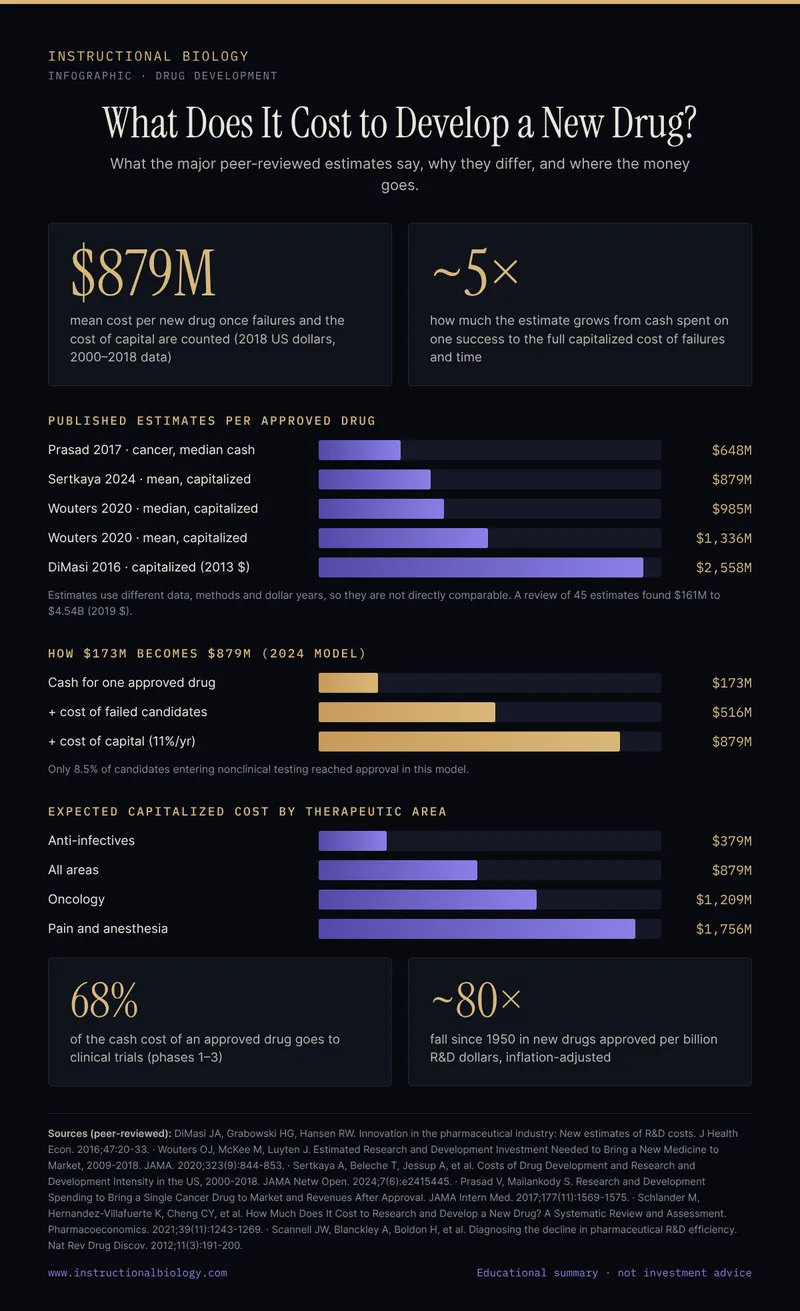
The most widely cited figure comes from the Tufts Center for the Study of Drug Development.[1] DiMasi and colleagues surveyed 10 pharmaceutical firms on 106 randomly selected new drugs. They estimated an average out-of-pocket cost of $1,395 million per approved compound, rising to $2,558 million once costs were capitalized at a real discount rate of 10.5% (all in 2013 dollars). Adding post-approval research brought the total to $2,870 million.[1]
A 2020 study in JAMA took a different route, using public filings. Wouters and colleagues found research and development data for 63 of the 355 new drugs and biologics approved by the US Food and Drug Administration (FDA) between 2009 and 2018. After accounting for failed trials, the median capitalized investment was $985.3 million and the mean was $1,335.9 million (2018 dollars).[2]
A 2024 analysis by researchers at the US Department of Health and Human Services and Eastern Research Group built a bottom-up model using data from 2000 to 2018, including per-patient costs from negotiated clinical trial contracts. Sertkaya and colleagues estimated a mean expected capitalized cost of $879.3 million per new drug (2018 dollars).[3]
For cancer drugs specifically, Prasad and Mailankody examined 10 companies that each brought their first drug to market between 2006 and 2015. The median development cost was $648.0 million, or $757.4 million with a 7% annual cost of capital, and the median development time was 7.3 years.[4]
A 2021 systematic review by Schlander and colleagues gathered 45 unique estimates from 22 studies. Converted to 2019 dollars, average capitalized pre-launch costs ranged from $161 million to $4.54 billion. The authors concluded that there is no universally correct answer to how much it costs, on average, to research and develop a new molecular entity.[5]
Why the estimates differ: three things being counted
The spread is easier to understand once you separate three layers of cost. The 2024 model reports all three for the same set of assumptions, which makes it a useful teaching example.[3]
- Cash spent on the drug that succeeds. The mean out-of-pocket cost of taking one approved drug from nonclinical work through postmarketing studies was about $172.7 million.[3]
- The cost of failures. Most candidates never reach approval; in the model, only 8.5% of drugs entering nonclinical testing were approved. Spreading the cost of those failures over each success raised the figure to $515.8 million.[3]
- The cost of capital. Money committed to a long program could have earned a return elsewhere. Applying a real cost of capital of 11.0% per year raised the figure again, to $879.3 million.[3]
In other words, the estimated cost increased about five-fold once failures and capital were counted.[3] Studies that quote out-of-pocket cash and studies that quote capitalized cost are answering different questions, so they should not be compared directly.
Data sources matter too. The Tufts estimate rests on confidential company survey data, while the JAMA study used public filings that were mainly available for smaller firms, orphan drugs, first-in-class drugs and products with accelerated approval.[1-3] The JAMA authors report that their results varied with assumptions about trial success rates, preclinical spending and the cost of capital.[2]
Therapeutic area changes the bill
Estimated costs vary widely with the disease being treated. In the JAMA study, median capitalized cost ranged from $765.9 million for nervous system agents to $2,771.6 million for antineoplastic and immunomodulating agents.[2] In the 2024 model, expected capitalized cost ranged from $378.7 million for anti-infectives to $1,756.2 million for pain and anesthesia drugs, with oncology at $1,209.2 million.[3] The systematic review also found the highest area-specific estimates for anticancer drugs, between $944 million and $4.54 billion.[5]
Part of the reason is the chance of success. In the 2024 model, the overall probability that an oncology candidate would reach approval was 4.1%, compared with 15.5% for anti-infectives.[3] When fewer candidates succeed, each approval has to carry more failed programs. Our explainer on why drugs fail clinical trials looks at those failure rates in more detail.
Where the money goes in the pipeline
Clinical trials are the largest single line item. In the 2024 model, phases 1 to 3 made up 68.0% of the mean cash cost of an approved drug. Phase 3 took the biggest share, mainly because it enrolled about 630 patients per trial on average, against about 51 in phase 1, and ran longer.[3]
Once failures and capital are included, the early work looks far more expensive. Nonclinical research was 6.8% of the cash cost, but 40.2% of the expected capitalized cost.[3] Early spending happens years before any revenue and is repeated across many candidates that never advance, so it accumulates both failure cost and time cost.
The long-run trend: more spending per approval
Over decades, the industry has spent more for each new medicine. Scannell and colleagues showed that the number of new drugs approved per billion US dollars of research spending halved roughly every nine years from 1950, a fall of about 80-fold in inflation-adjusted terms.[6] DiMasi's team found that total capitalized cost per approval rose at 8.5% per year above general inflation compared with their previous study.[1] The systematic review likewise identified a trend of increasing estimated costs per new molecular entity over time.[5]
Scannell's group proposed four primary causes, which they named the "better than the Beatles" problem, the "cautious regulator" problem, the "throw money at it" tendency and the "basic research-brute force" bias.[6] Paul and colleagues at Eli Lilly analysed each step of discovery and development to identify which steps contribute most to overall productivity, and proposed specific strategies to improve it.[7]
Which levers move the total
Because failures and time account for so much of the capitalized cost, the most powerful levers are the ones that improve the odds of success or shorten programs. The 2024 study concluded that costs associated with development failures were a major factor in total expected capitalized cost, and that improving the probability of moving from one stage to the next, for example through adaptive trial designs and biomarkers, can produce substantial savings.[3]
This is the logic behind in silico methods: testing more questions computationally before committing a candidate to expensive human trials. The aim is to stop weak candidates earlier, when stopping is cheap, and to advance strong ones with more confidence.
What this means for patients, partners and investors
For patients and the public, the key point is that no single number is "the" cost of a new drug. A headline figure should always come with three questions: does it include failures, does it include the cost of capital, and which diseases and companies does it cover?
For partners and investors, the published work points to the same priority. Substantial savings can come from earlier, better decisions about which candidates to advance, because every late-stage failure is paid for by the programs that succeed.[3,7]
That is the direction of our own research. Our thesis is that a biological reasoning system that maps how signaling molecules act across networks can help researchers judge earlier which candidates deserve a costly clinical program. This work is research-stage, and we are building and testing it now.
Sources
- DiMasi JA, Grabowski HG, Hansen RW. Innovation in the pharmaceutical industry: New estimates of R&D costs. J Health Econ. 2016;47:20-33. doi:10.1016/j.jhealeco.2016.01.012 · PMID 26928437
- Wouters OJ, McKee M, Luyten J. Estimated Research and Development Investment Needed to Bring a New Medicine to Market, 2009-2018. JAMA. 2020;323(9):844-853. doi:10.1001/jama.2020.1166 · PMID 32125404
- Sertkaya A, Beleche T, Jessup A, et al. Costs of Drug Development and Research and Development Intensity in the US, 2000-2018. JAMA Netw Open. 2024;7(6):e2415445. doi:10.1001/jamanetworkopen.2024.15445 · PMID 38941099
- Prasad V, Mailankody S. Research and Development Spending to Bring a Single Cancer Drug to Market and Revenues After Approval. JAMA Intern Med. 2017;177(11):1569-1575. doi:10.1001/jamainternmed.2017.3601 · PMID 28892524
- Schlander M, Hernandez-Villafuerte K, Cheng CY, et al. How Much Does It Cost to Research and Develop a New Drug? A Systematic Review and Assessment. Pharmacoeconomics. 2021;39(11):1243-1269. doi:10.1007/s40273-021-01065-y · PMID 34368939
- Scannell JW, Blanckley A, Boldon H, et al. Diagnosing the decline in pharmaceutical R&D efficiency. Nat Rev Drug Discov. 2012;11(3):191-200. doi:10.1038/nrd3681 · PMID 22378269
- Paul SM, Mytelka DS, Dunwiddie CT, et al. How to improve R&D productivity: the pharmaceutical industry's grand challenge. Nat Rev Drug Discov. 2010;9(3):203-214. doi:10.1038/nrd3078 · PMID 20168317