 Instructional Biology
Before a modern jet engine ever leaves the factory floor, it has already flown thousands of hours inside a computer. Engineers build a digital twin: a living model of that exact engine, updated as real-world data flows in, so they can see how it will behave under stress before they push the physical machine. The human body is far more complicated than any engine, yet medicine still doses it by the average and waits to see what happens. A patient digital twin is our answer: a flight simulator for one person's biology, where a dose can be tested before it reaches the bloodstream.
The myth of the average patient
Today a dose is calculated once, from a population average and a single snapshot of the patient, as if the body's internal signaling stood still. The result is familiar to every physician: the top-grossing drugs in the United States help between 1 in 25 and 1 in 4 of the people who take them.[1]
A clinical trial tells us how a population responded. A patient is one person, and that person changes from day to day. Getting from the trial result to the individual is the missing step in medicine. The patient digital twin is built to take that step.
A living hypothesis, not a snapshot
A digital twin is not a static picture from your last appointment. It is a computational model of one person's signaling that keeps updating as new measurements arrive. Health digital twins are generally described as virtual representations of a patient, built from that patient's own data, population data and real-time updates, which can be tested to anticipate how the real person will respond.[2] Just as aerospace engineers stress a virtual turbine before they run the real one, the twin predicts a person's response before a medicine is given.
The map before the territory
To model one patient, you first need a map of human biology. Our Advanced Science AI Platform, ASAP, reads the published literature finding by finding and builds the Signaling Cascade Knowledge Graph: which molecule turns which pathway up, which turns it down, and the paper that says so. As of October 28, 2026 it holds 16,993 PubMed papers and 13,822 nodes.
Biological signaling branches like a tree. A handful of master regulators fan out into thousands of downstream pathways and clinical outcomes. Flat space runs out of room for that kind of branching, so our map lives in hyperbolic space, a Poincaré ball, where room grows exponentially toward the edge, just as biology branches. Activation and inhibition are kept apart rather than averaged into nothing. You can explore a public view of the map in our Poincaré Explorer.
Warping the map to fit one person
That map describes an average human baseline, and no two patients share the same biology. So the next step is to reshape the map for one person. The twin takes the general signaling baseline and warps it with that patient's own data: their genetic variants, how their body metabolizes drugs, and their clinical history. Population data becomes n=1.
The operating loop: wearables and continuous measurement
A twin has to live in real life, not in a vacuum. Wearable sensors stream signals such as heart rate, temperature and sleep. Each person's readings are calibrated against clinical reference measurements, including electrochemical aptamer-based sensors, a technology that has tracked drug levels in the bloodstream of living animals continuously and in real time.[3] A transfer function fitted to that one person maps each signal onto their part of the map, so the twin knows what the body is doing now, not what it was doing at the last visit.
Comparing prediction with reality
The twin predicts each response in the same units the body is measured in, so prediction and measurement can be compared directly. When the measured response drifts away from the predicted one, the twin computes a revised plan, such as a different dose, a different combination or a different dosing interval, to bring the body back toward balance.
Safety: clinician-bounded and hardware-locked
The twin cannot invent a dose out of thin air. It can only propose changes inside limits the prescriber sets in advance: a maximum, a minimum and a safe fallback. Anything outside those limits is withheld and sent to the physician for review. The AI maps the pathways and proposes; physicians review the evidence, set the limits and make the final decisions.
The limits are also enforced in the delivery device itself. If the wearable sees the body reacting outside the doctor-approved limits, or a software fault ever sends a command outside them, the device stops and returns to the prescriber's safe setting, and the event is recorded. Real-world data is noisy, so the twin is built to be cautious. It sets aside readings confounded by movement or poor skin contact, trusts old data less, and stops rather than guessing beyond the conditions it was qualified for.
Two twins: everyday and prescribed
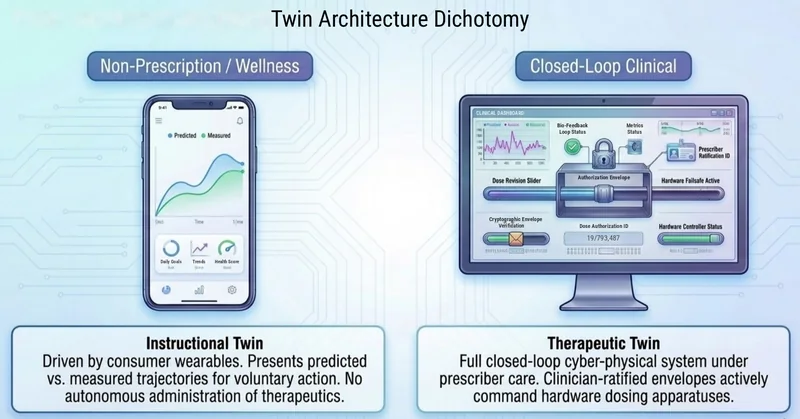
The same twin runs in two configurations. The Instructional Twin, for everyday wellness, runs on the wearables people already own. It shows what the twin predicted next to what the body actually did, and it never administers anything. The Therapeutic Twin works under a prescriber's care: it computes dosing changes inside the prescriber's limits and can drive a dose-delivery device. If a person moves from one to the other, their calibration carries over, so they do not start again.
Virtual cohorts and trials of one
Run many individual twins at once and you get a virtual cohort: the spread of responses across many different biologies, computed before a physical trial begins. Trials can then be designed around the individual, and de-identified outcomes can be pooled to compare options without leaning on a single population average. We wrote more about this in In Silico: Testing Biology Before You Touch It.
The loop that keeps learning
The twin does not only use data; it creates it. Real-world dosing responses flow back into ASAP and the knowledge graph, so every patient makes the map more accurate for the next one. Discovery, manufacturing, making safe, delivery and dosing become one continuous loop, from the map to the patient and back again.
Medicine made by the body, for the body, and now, medicine made for you.
Sources
- Schork NJ. Personalized medicine: Time for one-person trials. Nature. 2015;520(7549):609-611. doi:10.1038/520609a · PMID 25925459
- Venkatesh KP, Raza MM, Kvedar JC. Health digital twins as tools for precision medicine: Considerations for computation, implementation, and regulation. NPJ Digit Med. 2022;5(1):150. doi:10.1038/s41746-022-00694-7 · PMID 36138125
- Arroyo-Currás N, Somerson J, Vieira PA, et al. Real-time measurement of small molecules directly in awake, ambulatory animals. Proc Natl Acad Sci U S A. 2017;114(4):645-650. doi:10.1073/pnas.1613458114 · PMID 28069939